
Zoning Regulations

Key Takeaways
- Zoning is the first legal gate for any STR — no permit or license can override a zone that prohibits short-term rentals
- Common residential designations (R-1, R-2) may allow, conditionally permit, or ban STRs depending entirely on the jurisdiction
- A conditional use permit can unlock STR eligibility in zones where it is not automatically allowed — but approval is not guaranteed
- Zoning is separate from HOA restrictions; hosts must comply with both simultaneously
- Heavily zoned markets have fewer active listings and higher minimum-stay floors, compressing supply and reshaping who you can host
How Zoning Shapes STR Eligibility
Zoning codes group land into categories and attach a list of permitted uses to each. Where that list includes STRs, you can apply for any required permit. Where it does not, operation is illegal regardless of what other paperwork you hold.
| Zoning Designation | Typical STR Treatment |
|---|---|
| Residential (R-1, R-2) | Varies sharply by city — may allow with permit, require owner-occupancy, or ban entirely |
| Mixed-use | Frequently permits STRs alongside retail and multifamily uses with a standard STR permit |
| Commercial (C-1, C-2) | Usually permits short-term accommodations; fewer restrictions on guest capacity |
| Agricultural / Rural | Wide variation; some jurisdictions allow agritourism STRs as accessory uses |
| Historic districts | Base zoning may allow STRs, but overlay rules add design review and operational constraints |
| Planned unit developments | Governed by individual development covenants; zoning code may defer to recorded PUD documents |
Regulatory Approaches and Their Impact on Supply
Cities do not share a single philosophy on STR zoning. The resulting patchwork shapes both who can operate and how many listings exist in a market.
Permissive approach — STRs are allowed across all or most residential zones with a standard permit. Many resort-driven communities default here to capture tourism revenue while retaining some oversight.
Tiered approach — Owner-occupied STRs (a host renting their primary home) are allowed in more zones than investment properties. This is the most common structure in mid-size cities navigating housing affordability concerns alongside tourism demand.
Restrictive approach — STRs are confined to commercial or mixed-use zones, or allowed in residential zones only via a conditional use permit. Non-owner-occupied rentals face the heaviest restrictions under this model.
Overlay districts — Some cities layer STR-specific overlay zones on top of base zoning, permitting short-term rentals in defined areas — often near tourist corridors — regardless of the underlying residential designation.
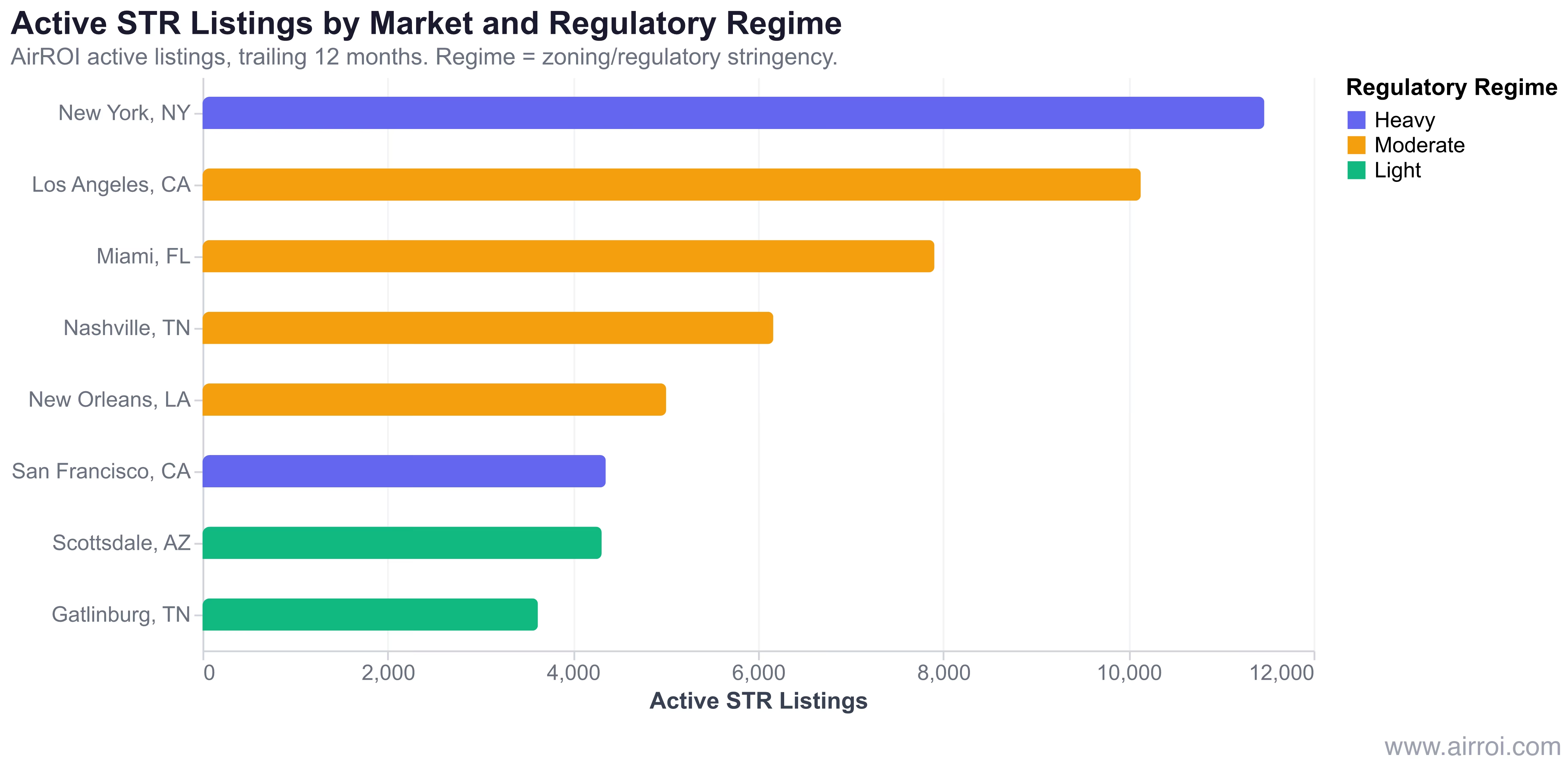
In AirROI's analysis of 57,721 active listings across these eight markets, the correlation between regulatory regime and listing supply is direct. New York (Heavy regime, 11,468 active listings) achieves that count only because the city is enormous — on a per-capita basis, its lightly-regulated counterparts far outpace it. More telling is the minimum-stay floor: New York's median minimum stay sits at 25.8 nights, a direct artifact of zoning enforcement that effectively prohibits short-stay rentals. Gatlinburg (Light regime, 3,622 listings in a small mountain town) runs a 2.1-night median minimum stay, and Scottsdale (Light regime) generates median annual revenue of $49,153 — nearly double New York's $21,970 — with 4,310 listings in a fraction of the population.
Zoning does not just determine legality — it sets the operating floor. A zone that mandates 30-day minimums transforms an STR into a medium-term rental in everything but name.
Why Zoning Matters Before You Buy
Zoning is irreversible on the investor's timetable. Unlike permits, which can often be applied for post-purchase, zoning designations change slowly through municipal re-zoning processes that can take years and require political action. Purchasing a property assuming STR-friendly zoning — and discovering after closing that the zone prohibits it — is one of the most costly mistakes in STR due diligence.
- Feasibility ceiling: A prohibited zone forecloses the investment thesis; no amount of permitting work or platform optimization recovers it
- Property value premium: Properties in verified STR-eligible zones trade at a meaningful premium because buyers price in the income potential
- Permit prerequisite: Zoning compliance is typically a mandatory declaration on any STR permit application — a mismatch triggers automatic denial
- Regulatory drift: Zoning codes are living documents; markets that permitted STRs in residential zones in 2018 may have amended those codes since. The small-city ordinance wave shows this trend reaching markets well beyond major metros
How to Research Zoning for Your Target Property
- Identify the zoning designation — Look up the address on your city or county's online GIS portal or zoning map; every parcel carries a designation (R-1, MU-2, etc.)
- Read the permitted uses list — The zoning code for that designation will explicitly list "short-term rental," "vacation rental," or "transient occupancy" as permitted, conditionally permitted (requires a CUP), or prohibited
- Check for overlays — Search for any STR overlay, tourist commercial overlay, or historic district overlay that modifies the base zone's rules
- Confirm with the planning department — For ambiguous language or recently amended codes, call or email; ask specifically about owner-occupied vs. non-owner-occupied STR treatment
- Track pending amendments — Monitor city council agendas and the local planning commission calendar for proposed zoning changes; a re-zoning that eliminates STR eligibility can be proposed and adopted within months
Frequently Asked Questions
Check your city or county's online zoning map and look up your property's designation (R-1, R-2, C-1, etc.). The zoning code for that designation will list permitted, conditional, and prohibited uses. Call your local planning department to confirm your interpretation — especially if STRs appear in a gray area — and check for any overlay districts that add STR-specific rules on top of the base zone.
In some jurisdictions, yes. If your zone prohibits STRs, you may apply for a zoning variance or conditional use permit. The process typically requires a public hearing, neighbor notification, and a demonstration that the STR will not harm the neighborhood character. Approval is not guaranteed — many planning boards deny variances that could set precedent — and processing can take several months.
Operating in a prohibited zone can trigger code-enforcement violations, fines ranging from $500 to $5,000 per day, orders to cease operations, and difficulty obtaining any future permits. Some cities pursue liens against non-compliant properties, and Airbnb now coordinates with municipalities to delist listings that lack required zoning authorization.
Directly. AirROI data shows heavily regulated markets — where zoning is a central enforcement tool — have sharply constrained supply relative to population. New York, which uses strict primary-residence zoning enforcement, has median minimum stays of 25.8 nights because short-stay listings are effectively banned by zoning and Local Law 18. Lightly regulated Gatlinburg, where residential zoning permits STRs broadly, supports a 2.1-night median minimum and over 3,600 active listings in a small market.