
Non-Owner-Occupied Rental

Key Takeaways
- Non-owner-occupied STRs are investment or vacation properties where the owner is absent during guest stays — the highest-scrutiny STR classification
- Many major cities prohibit NOO STRs entirely through primary residence requirements; permissive markets like Scottsdale and Gatlinburg allow them with standard permits
- AirROI data shows median annual revenue in light-regulation NOO markets (
$49,800) runs roughly 78% higher than in heavy-regulation markets ($27,900) - A conditional use permit is often required on top of a standard STR permit, along with a local agent designation and $1M+ liability coverage
- Regulatory risk — not occupancy or ADR — is the primary due-diligence variable for NOO STR investment decisions
What Makes a Rental "Non-Owner-Occupied"
The classification is operational, not legal: an STR is non-owner-occupied whenever the owner is not present as a primary resident during guest stays. The boundary matters because cities use it as the main lever for limiting "commercial" short-term rental activity.
| Classification | Owner Present? | Primary Residence? | Regulatory Treatment |
|---|---|---|---|
| Owner-occupied | Yes, during most stays | Yes | Lighter — fewer permits, often night-cap exemptions |
| Non-owner-occupied | No | No (investment / vacation property) | Heaviest — additional permits, density caps, possible ban |
| Hosted rental | Yes, on-site (e.g., spare room) | Yes | Lightest — most cities treat as de minimis |
The distinction shows up directly in permit applications. Cities that issue both types typically cap the number of NOO permits per zone and charge higher fees, creating artificial supply constraints that benefit existing permitted operators.
How Non-Owner-Occupied Rentals Are Regulated
| Regulatory Dimension | Typical NOO Treatment |
|---|---|
| Permitting | Standard STR permit + often a conditional use permit (CUP) |
| Zoning | Restricted to fewer zones; frequently banned in R-1 residential |
| Night limits | Subject to annual night caps with no owner-occupied exemptions |
| Insurance | Liability coverage minimums often $1M+; commercial policy may be required |
| Taxes | Full transient occupancy tax (TOT) plus potential additional assessments |
| Local agent | Many cities require a designated contact within 30–60 minutes of the property |
| Density caps | Per-neighborhood percentage limits on NOO permits are increasingly common |
Revenue Reality Across Regulatory Regimes
The regulatory environment — more than market size or tourism volumes — determines what a NOO STR can earn. Markets that restrict absentee ownership compress supply while also raising compliance costs; markets that permit NOO STRs freely generate meaningfully higher returns.
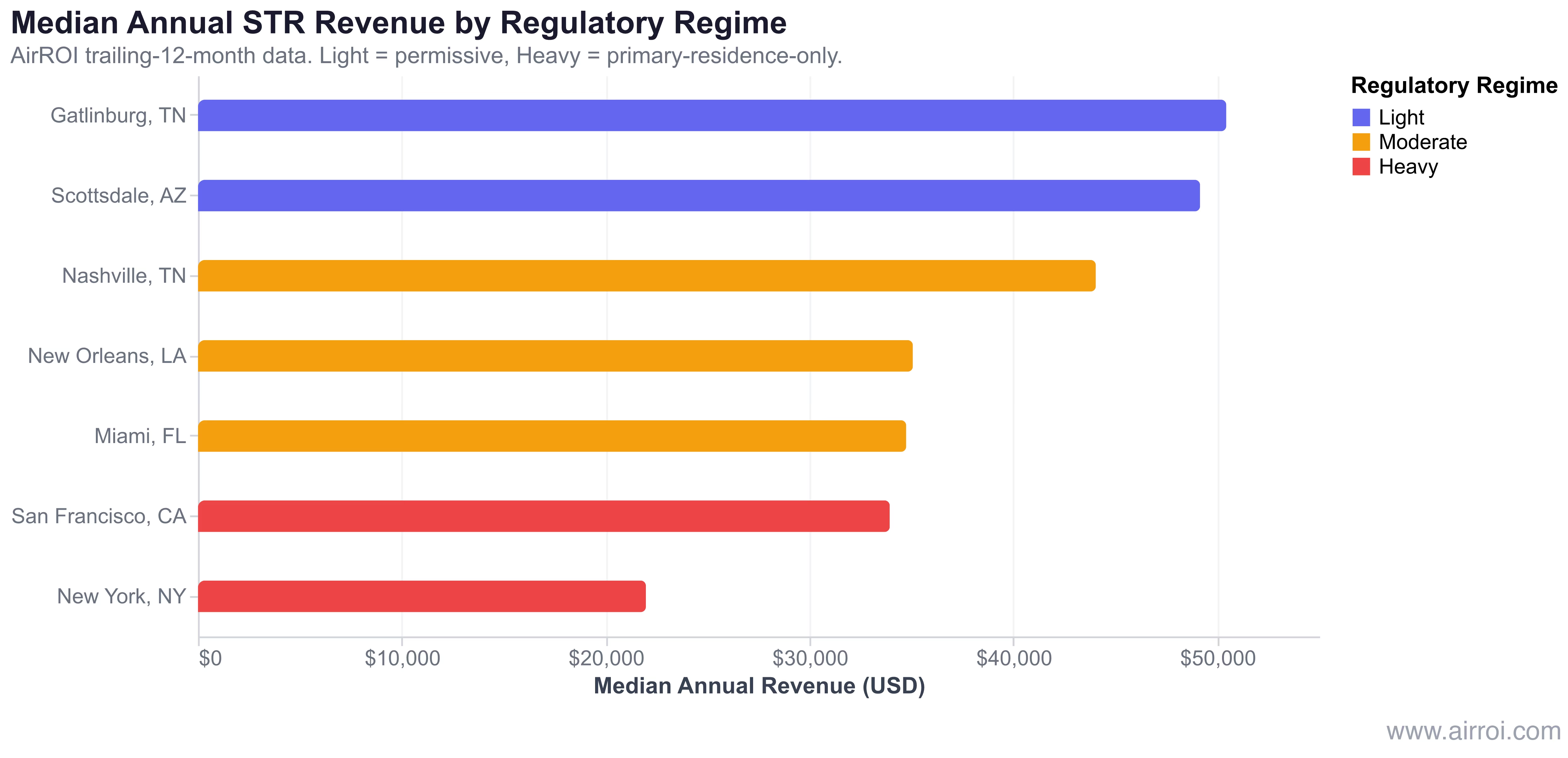
In AirROI's analysis of 64,421 active listings across Gatlinburg, Scottsdale, Nashville, New Orleans, Miami, San Francisco, and New York, lightly regulated markets returned median annual revenues of $50,438 (Gatlinburg) and $49,153 (Scottsdale), while heavily regulated markets capped out at $33,932 (San Francisco) and $21,970 (New York). Nashville's moderate-regime $44,039 reflects its permit cap — limited supply props up revenue for the operators who hold permits.
The NOO regulatory regime is effectively a revenue ceiling: light-touch markets don't just have fewer compliance costs — they have structurally higher earning potential because the property can operate as a genuine nightly rental rather than a minimum-30-day stay.
Regulatory Landscape for Non-Owner-Occupied STRs
| Market Approach | Examples | Conditions |
|---|---|---|
| Prohibited | San Francisco, New York, Boston | Primary residence required; NOO permits not issued |
| Capped permits | Nashville, New Orleans | Limited permits per zone; waitlists common; density caps enforced |
| Zoning restricted | Denver, Portland | Allowed only in specific commercial or mixed-use zones |
| Generally permitted | Scottsdale, Gulf Shores, Gatlinburg | Standard permit + tax compliance; no residency requirement |
| State preemption | Florida, Arizona, Texas (most cities) | State law prevents cities from banning STRs outright, protecting NOO owners |
Why NOO Classification Changes the Investment Calculus
Permit scarcity as a moat. In capped-permit markets like Nashville (6,165 active listings at $44,039 median annual revenue), the difficulty of obtaining a NOO permit once caps are reached creates a durable competitive advantage for existing holders. Density caps, often cited as a restriction, function equally as a barrier to entry.
Platform enforcement. Airbnb increasingly requires permit numbers at listing creation and audits for compliance. An unlicensed NOO listing faces not just municipal fines but platform delisting — the operational equivalent of a full permit revocation.
Strategies for Non-Owner-Occupied STR Investors
- Research before purchasing — Confirm both current NOO permit availability and the trend in local ordinances; review the last three years of city council agendas for STR discussions
- Target permissive or state-preempted markets — Markets in Florida, Arizona, and Texas have structural legal protection against municipal bans on NOO STRs
- Secure permits immediately — In capped-permit markets, apply on closing day; waitlists open and close unpredictably
- Budget for true compliance costs — Model insurance premiums, professional management (typically 15–30% of revenue), local agent fees, and permit renewal costs before projecting returns
- Diversify regulatory exposure — Concentrating NOO investment across a single jurisdiction creates binary regulatory risk; spreading across two or three distinct regulatory regimes reduces it
- Monitor legislation actively — Attend city council meetings and join local host associations; regulatory changes that are visible 6–12 months before adoption can be acted on by repositioning or selling ahead of enforcement
Frequently Asked Questions
Yes, in many markets — but legality depends entirely on local ordinances. Cities like Scottsdale, Gatlinburg, and most of Florida permit non-owner-occupied STRs with a standard permit, while San Francisco, New York, and Boston enforce primary-residence requirements that effectively prohibit them. Always verify current rules at the city or county level before purchasing.
Beyond a standard STR permit, non-owner-occupied properties often require a conditional use permit from the zoning board, a separate business license, enhanced liability insurance (frequently $1 million or more), and a designated local agent reachable within 30–60 minutes. Density caps may also apply, limiting how many NOO permits are issued per neighborhood.
Yes, when the market is chosen carefully. AirROI data shows lightly regulated markets like Gatlinburg and Scottsdale generate median annual revenues of $50,438 and $49,153 respectively, versus $21,970 in heavily regulated New York. Regulatory compliance costs — permits, insurance, management, local agent fees — must be modeled against that revenue ceiling before committing.
Directly and substantially. AirROI's trailing-12-month data across seven markets shows median annual STR revenue in light-regulation markets averaging roughly $49,800 versus $27,900 in heavy-regulation markets — a gap driven by lower minimum-stay constraints, broader zoning eligibility, and higher permit availability for investment owners.