
Dynamic Pricing Tool

Key Takeaways
- Dynamic pricing tools automate rate adjustments using algorithms that continuously ingest booking pace, competitor rates, local events, and seasonal demand curves
- Third-party tools like PriceLabs and Beyond outperform Airbnb's built-in Smart Pricing for most hosts, typically delivering 10–40% more annual revenue than static pricing
- The tool's output is bounded by the host-defined base price, minimum price, and maximum price — getting these guardrails right is as important as the algorithm itself
- ADR across major STR markets spans from $221 to $421 (trailing 12 months, per AirROI) — that $200 spread is precisely the range a dynamic pricing tool must navigate to maximize RevPAR
- Integration with a property management system (PMS) enables seamless rate updates across all booking channels simultaneously
How Dynamic Pricing Tools Work
Dynamic pricing tools follow a continuous analyze-recommend-push cycle that repeats daily or multiple times per day:
- Data ingestion — The tool collects real-time data including comparable listing rates, booking pace, local event calendars, day-of-week patterns, and historical occupancy curves
- Algorithm processing — Machine learning models calculate a demand multiplier based on aggregated signals, weighting factors such as lead time, market saturation, and seasonal momentum
- Rate recommendation — The multiplier is applied to your base price to produce a nightly rate, capped by your min/max guardrails
- Rate push — The recommended rate is automatically synced to connected booking platforms via API or PMS integration — no manual update required
- Continuous optimization — The cycle repeats, adjusting rates as booking pace, competitor moves, and proximity to check-in date evolve
Key Inputs That Drive Rate Adjustments
| Input | Impact on Rate | Example |
|---|---|---|
| Local demand surge | Increase | Concert or festival weekend |
| Slow booking pace | Decrease | Midweek in off-season |
| Competitor rate change | Adjust to stay competitive | Comparable listings drop rates |
| Lead time | Varies | Last-minute gaps may trigger discounts |
| Day of week | Weekend premium | Friday–Saturday rates higher |
| Seasonality | Seasonal adjustment | Summer premium in beach markets |
ADR Across STR Markets: The Pricing Range Tools Must Navigate
The spread in average daily rates across US markets illustrates exactly why automation is necessary. In AirROI's analysis of approximately 43,900 active listings across seven markets, median ADR varies by nearly $200 — from $221.50 in Denver to $421.10 in Scottsdale.
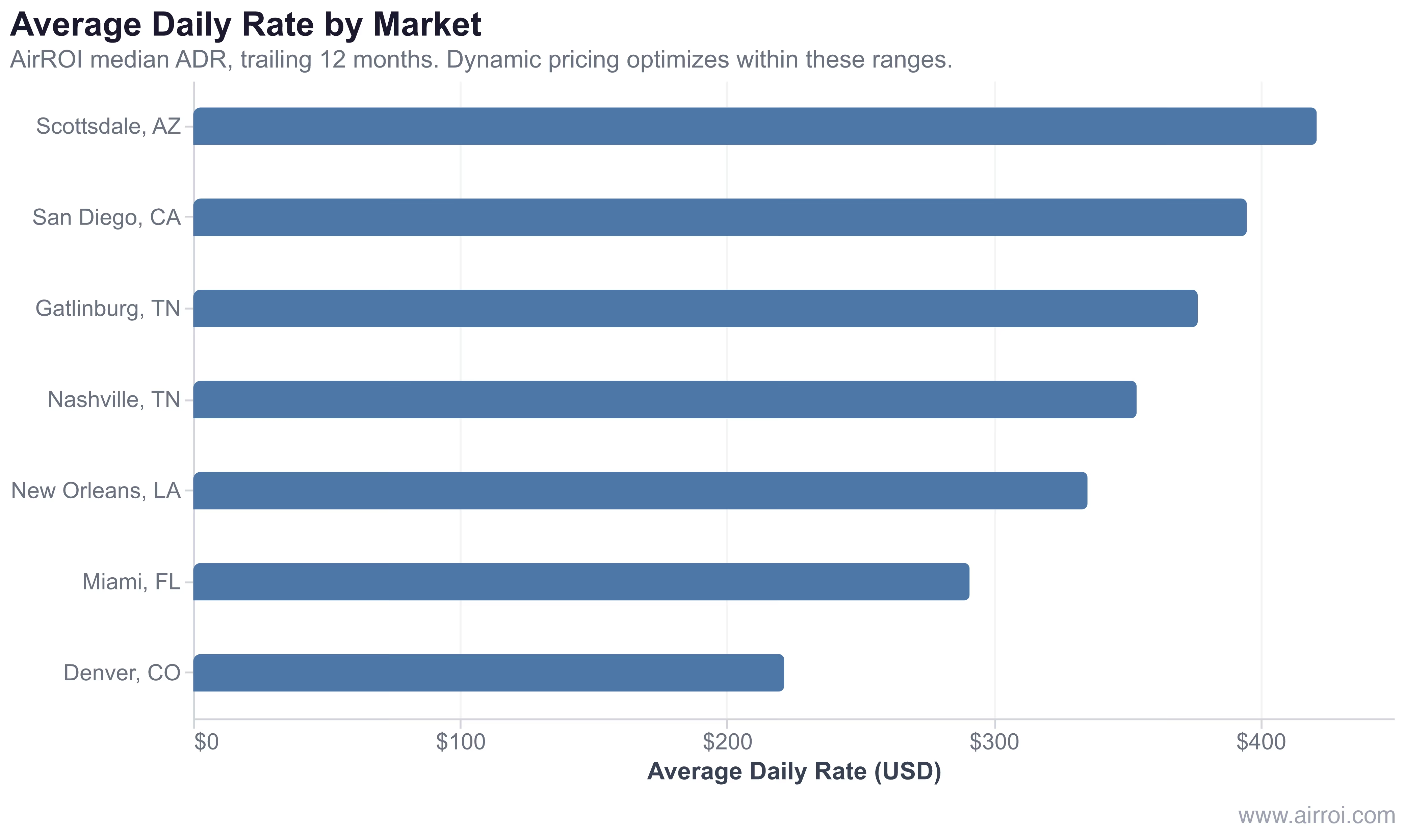
A static rate set for a Nashville listing's average demand period will leave money on the table every festival weekend (when Scottsdale-level rates are achievable) and accumulate vacant nights every slow Tuesday. The algorithm's job is to move the rate across that full range dynamically — capturing the peaks without sacrificing the fill.
The case for dynamic pricing tools is not that they're smarter than hosts on any single night — it's that they process hundreds of market signals simultaneously, every day, across every night on your calendar, without the cognitive load that makes manual pricing unsustainable beyond a listing or two.
Top Dynamic Pricing Tools Compared
| Tool | Pricing Model | Key Strength | Best For |
|---|---|---|---|
| PriceLabs | ~$20–30/mo per listing | Granular customization, market dashboards | Data-driven hosts, analysts |
| Beyond | ~1% of revenue | Simplicity, broad PMS integrations | Property managers |
| Wheelhouse | ~1% of revenue | Flexible strategy presets, portfolio view | Multi-property optimization |
| DPGO | ~$1/active night | Deep control, affordability | Advanced single-property users |
| Airbnb Smart Pricing | Free | Zero setup, built-in | Beginners, single listings |
Why Dynamic Pricing Tools Matter for STR Revenue
- ADR maximization: Capturing peak-demand premiums that a flat rate would miss, directly improving ADR and RevPAR
- Vacancy reduction: Automatically reducing rates during soft demand periods to fill nights before they go unsold — an empty night is permanent lost revenue
- Time savings: Eliminating the daily task of researching market rates and updating prices across platforms, which for a multi-listing portfolio is a multi-hour weekly commitment
- Market-aligned pricing: Staying competitive without guesswork — the algorithm processes more comp-set data points per hour than any host could track manually
- Portfolio scalability: Managing optimal rates across 5, 50, or 500 listings through a single platform, which is why professional operators treat dynamic pricing software as foundational infrastructure
Tips for Maximizing Your Dynamic Pricing Tool
- Set an accurate base price — the algorithm multiplies around it; an incorrect base skews every recommendation. Revisit it quarterly as market conditions shift.
- Define sensible min/max boundaries — your minimum should cover all operating costs plus a margin; your maximum should reflect the upper limit the market will sustain for your property type and quality tier.
- Layer in manual overrides for confirmed major events — algorithms sometimes undervalue high-demand local events that haven't yet appeared in booking data; check and override rates for known peaks at least 90 days out.
- Audit the comp set — most tools let you define comparable listings. An inaccurate comp set (e.g., luxury comps for a budget property) will produce systematically wrong recommendations.
- Review performance monthly — compare your ADR and occupancy against market benchmarks using a tool like AirROI to confirm the software is genuinely outperforming your previous baseline.
Frequently Asked Questions
PriceLabs is the top choice for data-driven hosts who need granular customization and deep market comp sets. Beyond (formerly Beyond Pricing) is preferred by property managers for its simplicity and broad PMS integrations. Wheelhouse offers flexible strategy presets for multi-property portfolios. For hosts just starting out, Airbnb's free Smart Pricing is a baseline, though third-party tools consistently produce higher annual revenue by setting more aggressive peak-demand rates.
PriceLabs charges approximately $20–30 per month per listing with volume discounts starting around 20 listings. Beyond and Wheelhouse both charge roughly 1% of booked revenue. DPGO charges about $1 per active night. Airbnb Smart Pricing is free but offers limited customization. Most paid tools offer free trials, making it straightforward to compare revenue performance before committing.
Yes — host data and independent studies consistently show dynamic pricing tools increase annual revenue by 10–40% versus static pricing. The gains come from two directions: capturing elevated ADR during high-demand periods that flat rates miss, and reducing vacancy in soft periods by automatically lowering rates to attract bookings before nights go unsold.
Most tools ingest booking pace, competitor rates for comparable listings, local event calendars, day-of-week patterns, historical occupancy by date, and seasonality curves. Advanced platforms also factor in lead time — how far in advance a booking arrives — and last-minute gap discounts to maximize calendar fill without sacrificing average rate.
Start with an accurate base price that reflects your property's quality tier — the algorithm multiplies around it, so an off-base price skews every recommendation. Then define a sensible minimum (your all-in cost plus margin) and a realistic maximum for your market. Audit the comp set the tool selects, correct any mismatches, and review monthly performance against your market's ADR benchmark to confirm the tool is outperforming your previous static rate.