Short-Term Rental Payment Ban: Clark County's 2026 Ordinance

There are 13,782 active short-term rental listings in unincorporated Clark County, Nevada. The county has issued 229 licenses. That gap — roughly one license for every sixty listings — is the reason a short term rental payment ban for unlicensed properties reaches the Board of Commissioners on August 4, 2026, and it is also the reason the proposal is more interesting than the ordinance it amends.
The county already tried the obvious thing. Its earlier rules required Airbnb and Vrbo to verify licenses, monitor listings, and take down the ones that failed. A federal judge blocked those provisions in August 2025. So the county is not asking platforms to remove anything this time. It is asking them not to get paid.
A fine is a cost a determined operator prices into the nightly rate. A blocked payment is not a cost. It is an off switch.
The off switch: what Clark County actually proposed
The proposal bars hosting platforms from completing a payment transaction for an unlicensed short-term rental — and it deliberately leaves advertising alone. As of this writing it is a proposal, not law. It is scheduled to be heard by the Clark County Board of Commissioners on August 4, 2026, and nothing changes unless the board adopts it.
"The County won't prohibit unlicensed short-term rentals from being advertised on the hosting platform but would prohibit the platform from completing a transaction for the rental of an unlicensed short-term rental."
Read that twice. The listing may stay up. The photographs, the calendar, the reviews, the nightly rate — all of it remains published. What the ordinance reaches is the moment the guest's card is charged. Penalties attach to the platform rather than the host, and include daily fines and, at the far end, revocation of the platform's ability to operate in the county.
This is categorically different from a citation. Ann Arbor tickets unlicensed operators between $200 and $1,000 per offense. Salt Lake City can fine them up to $1,000 every seven days. Those are real numbers, and a professional operator running a property at a $281 average daily rate can absorb them as an expense line while continuing to book. Payment interdiction removes the revenue that would pay the fine. The economics invert.
The scale is not hypothetical. AirROI's June 2026 snapshot counts 13,782 active listings across unincorporated Clark County. Of those, 5,901 recorded booking activity over the trailing twelve months, generating $184.8 million in revenue — an average of $31,315 per active listing. That is the money the mechanism is aimed at.
Why cities stopped chasing hosts
Host-level enforcement fails for a structural reason: cities cannot see the addresses. Every other problem with it — cost, staffing, complaint backlogs — follows from that one.
Carol Duncan, city attorney for Jonesboro, Arkansas, put it more plainly than any ordinance ever has, speaking to a Public Safety Council Committee meeting reported on July 24, 2026:
"We don't even have a way to know where they are, if they don't come in and get their privilege license, because if you booked on Airbnb, you don't find out the address until you put your credit card in."
The address is disclosed after payment. That single design feature of the booking flow defeats conventional code enforcement, because code enforcement begins with a location. A city that wants to inspect an unlicensed rental must first buy a night in it.
"I haven't noticed any concentration (of short-term rentals) yet… I can tell you where they're not." — Nathan Katona, Columbus Building Director
Detection can be purchased. Ann Arbor, Michigan contracts with Deckard Technologies, whose Rentalscape product scans listing platforms and delivers reports every two weeks; the scanning surfaced several hundred unregistered rentals against about 300 licensed units as of June 2026. Jonesboro is weighing a comparable service after learning that Hot Springs and Bella Vista pay around $80,000 for one.
But detection is not enforcement. It produces a list, and the list still has to be worked property by property, notice by notice, hearing by hearing. Winnipeg's experience is instructive: its bylaw took effect April 1, 2024, licensed listings have risen from roughly 700 to about 870 over the past year, and complaints have more than doubled in the same period. The city is now reviewing the bylaw, with a report recommending changes expected before council this fall.
Riverside County Supervisor Chuck Washington framed the stakes bluntly when his board revised its ordinance on July 28, 2026:
"Enforcement, accountability and stop the nuisance. If we can't achieve those, then this ordinance will be worthless."
The Section 230 line that pushed cities to the payment rail
Clark County switched mechanisms because a federal judge blocked the first one. This is the part of the story that explains everything else, and it has been almost entirely absent from coverage of the proposal.
On August 28, 2025, U.S. District Judge Miranda Du enjoined the county's "platform provisions" — the requirements that booking sites verify county licenses, monitor listings for compliance, and deactivate unlicensed ones. The reasoning turned on Section 230 of the Communications Decency Act, which bars treating an online service as the publisher of content its users create. The duty to verify, monitor and deactivate host listings, the court concluded, effectively required the platform to police third-party content. The Board of Commissioners voted to appeal on January 6, 2026, and that appeal remains pending.
Now look again at how carefully the new proposal is worded. Advertising untouched. Only the transaction barred. That is not lawyerly fussiness; it is the county moving its ordinance across a line that courts have already drawn.
The line comes from HomeAway.com, Inc. v. City of Santa Monica, 918 F.3d 676 (9th Cir. 2019). Santa Monica's ordinance made it unlawful for platforms to complete booking transactions for properties not on the city's registry. Airbnb and HomeAway argued Section 230 preempted it. The Ninth Circuit — the same circuit that governs Nevada — unanimously disagreed and upheld the ordinance, reasoning that an obligation not to process a transaction regulates the platform's own commercial conduct rather than its publication of someone else's listing.
| Make the platform police listings | Make the platform not complete the sale | |
|---|---|---|
| What it requires | Verify licenses, monitor listings, deactivate non-compliant ones | Do not process a booking transaction for an unregistered property |
| What it touches | Third-party content (publishing) | The platform's own commercial conduct |
| Section 230 exposure | High — resembles publisher liability | Lower — not a publishing decision |
| Leading outcome | Clark County provisions enjoined, Aug 28 2025 | Santa Monica ordinance upheld, 9th Cir. 2019 |
| Where Clark County stands | Under appeal | Proposed; hearing Aug 4 2026 |
Two caveats belong here, and honesty about them matters more than a tidy narrative. First, a separate and earlier challenge to Clark County's ordinance ran through Nevada state court in 2022–2023 before a different judge; it is a distinct proceeding and should not be conflated with the federal Section 230 ruling. Second, that Santa Monica's ordinance survived does not guarantee Clark County's will. The ordinances differ in their particulars, the record is different, and the county is litigating from a weaker position than a city that never had its rules enjoined. What can be said accurately is narrower and still significant: the county has moved from the side of the line where it lost to the side where another local government won.
Which markets have license data — and which have none
Payment interdiction only functions where the platform actually holds license information, and that varies enormously by market. This is the practical constraint nobody discusses, and it determines where the mechanism can spread.
AirROI's June 2026 snapshot measures one specific thing: the share of active listings that publish a registration or license number. It is worth being precise about what that is and is not. It is an upper bound on verifiable licensure — a displayed number does not prove the number is valid — and it is a point-in-time cross-section, not a trend.
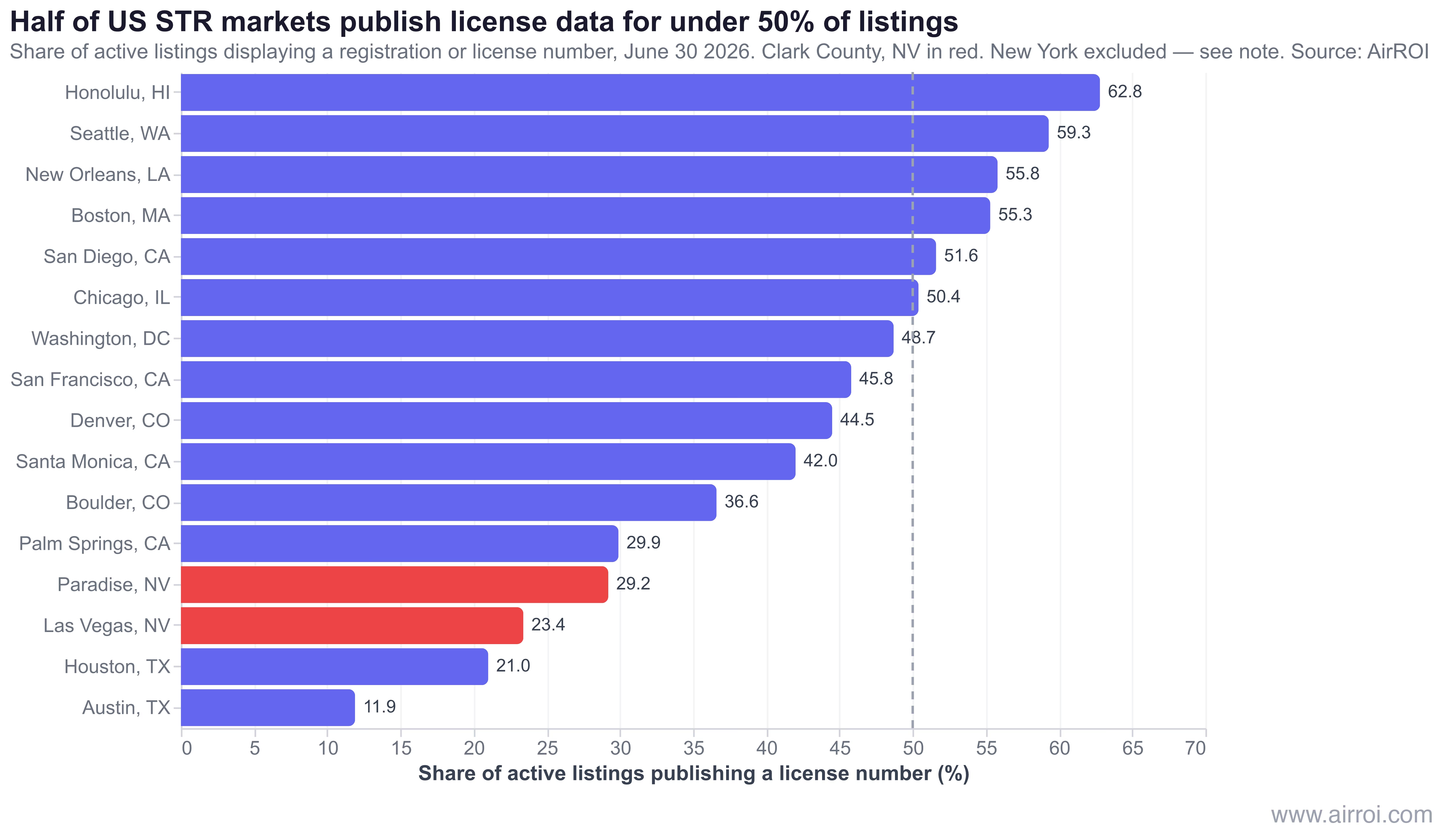
The spread is wide. Honolulu leads at 62.8%, followed by Seattle at 59.3%, New Orleans at 55.8% and Boston at 55.3%. San Diego and Chicago sit near the halfway mark. At the bottom: Las Vegas at 23.4% and Austin at 11.9%.
New York is deliberately excluded from this comparison, and the reason is instructive. Roughly 38% of the city's listings are offered with minimum stays of 30 nights or longer, which places them outside the definition of a short-term rental and therefore outside any registration requirement — a far higher share than any other market here. Counting them in the denominator makes the city look non-compliant when it is the opposite. Among New York listings where a sub-30-night minimum is observed, the overwhelming majority — more than nine in ten — do publish a registration number, which is what a transaction-level law looks like when it is working.
| Market | Active listings | Publish a license number | Share | ADR |
|---|---|---|---|---|
| Honolulu, HI | 10,351 | 6,501 | 62.8% | $276 |
| Seattle, WA | 11,124 | 6,592 | 59.3% | $239 |
| New Orleans, LA | 11,060 | 6,176 | 55.8% | $303 |
| Boston, MA | 5,834 | 3,229 | 55.3% | $291 |
| San Diego, CA | 21,370 | 11,020 | 51.6% | $363 |
| Chicago, IL | 13,733 | 6,928 | 50.4% | $249 |
| Washington, DC | 11,551 | 5,630 | 48.7% | $236 |
| San Francisco, CA | 9,613 | 4,400 | 45.8% | $266 |
| Denver, CO | 8,590 | 3,823 | 44.5% | $201 |
| Santa Monica, CA | 2,246 | 943 | 42.0% | $285 |
| Boulder, CO | 1,896 | 694 | 36.6% | $370 |
| Palm Springs, CA | 6,551 | 1,959 | 29.9% | $485 |
| Paradise, NV | 8,435 | 2,465 | 29.2% | $290 |
| Las Vegas, NV | 9,505 | 2,227 | 23.4% | $250 |
| Houston, TX | 24,601 | 5,173 | 21.0% | $206 |
| Austin, TX | 21,046 | 2,511 | 11.9% | $276 |
Source: AirROI, snapshot of June 30, 2026. New York is excluded — see above.
Percentages understate what is at stake. Converting share into absolute listings is what makes the mechanism concrete.
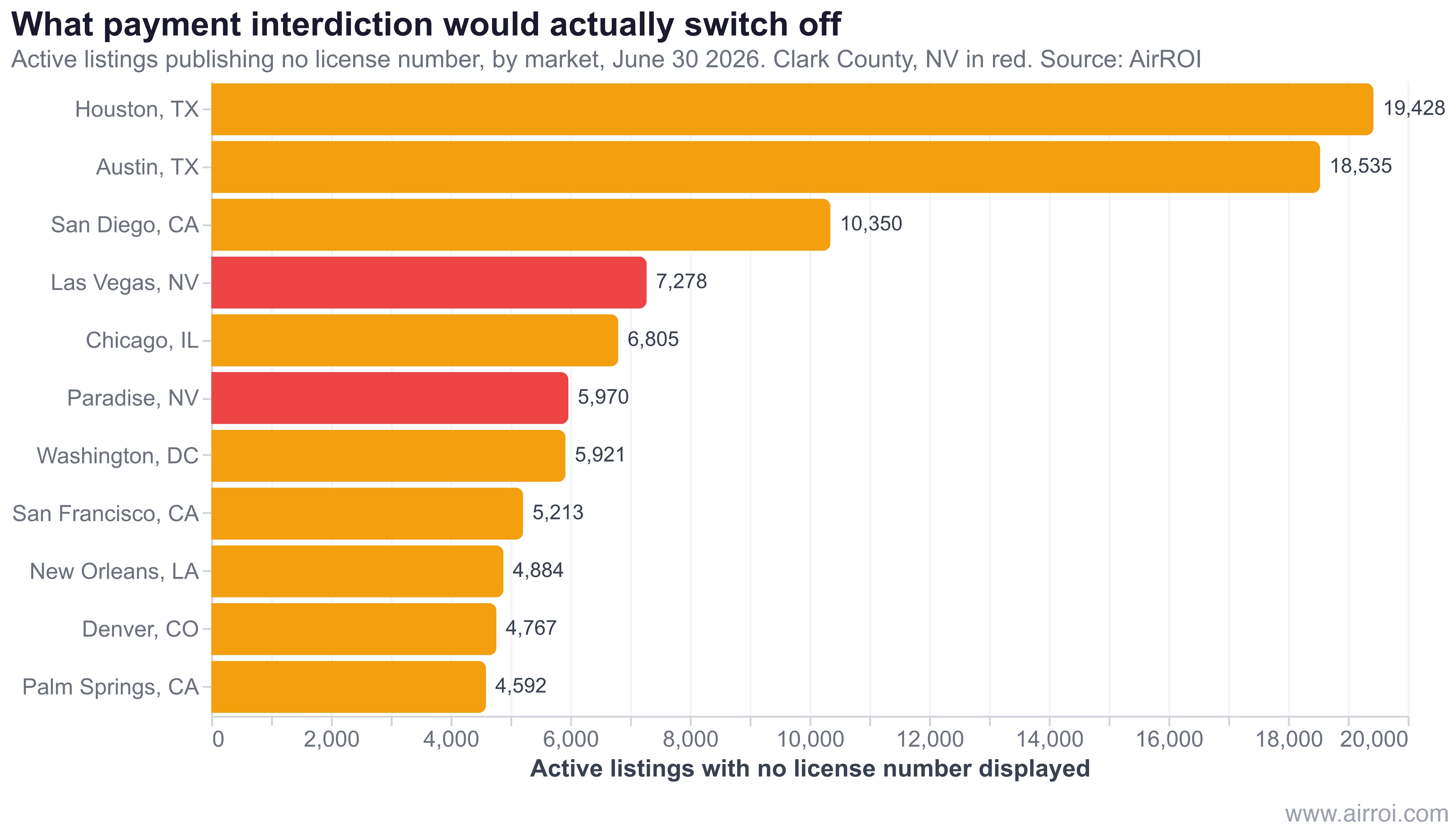
In Las Vegas, 7,278 active listings display no license number. In Houston the figure is 19,428 and in Austin 18,535. A rule that switched off payments for every listing without visible licensing would land on tens of thousands of properties in a single metro.
There is a second finding in this data that is easy to misread, so it deserves stating carefully. In a large group of markets — Salt Lake City, Charleston, Savannah, Phoenix, Myrtle Beach, Dallas — fewer than one listing in two hundred publishes a license number. This does not mean 99% of those listings are unlicensed. All of those cities operate registration schemes. It means the platform surfaces no license field there at all, so no listing-level license data exists to enforce against. Part of the explanation is state preemption: Arizona sharply limits what its cities may require of short-term rentals, and Phoenix, Scottsdale, Tucson and Mesa all cluster near half a percent.
For a city in that position, payment interdiction is not an available tool. There is nothing for the platform to check. Building the data pipeline has to come first — which is precisely what New York and New Orleans did before they reached for the payment rail.
"Unlicensed" is not a synonym for "scofflaw"
In unincorporated Clark County, the overwhelming majority of unlicensed operators could not obtain a license if they wanted one. This is the finding that should trouble anyone who reads the proposal as a straightforward crackdown on bad actors.
Run the arithmetic. A 1% cap against a housing stock measured in the hundreds of thousands produces a licensing capacity in the low thousands at most; the county has actually issued 229. AirROI counts 13,782 active listings. Even if every operator in unincorporated Clark County woke up tomorrow determined to comply, the scheme has no room for them. Licensing is not a test they are failing. It is a door that is closed.
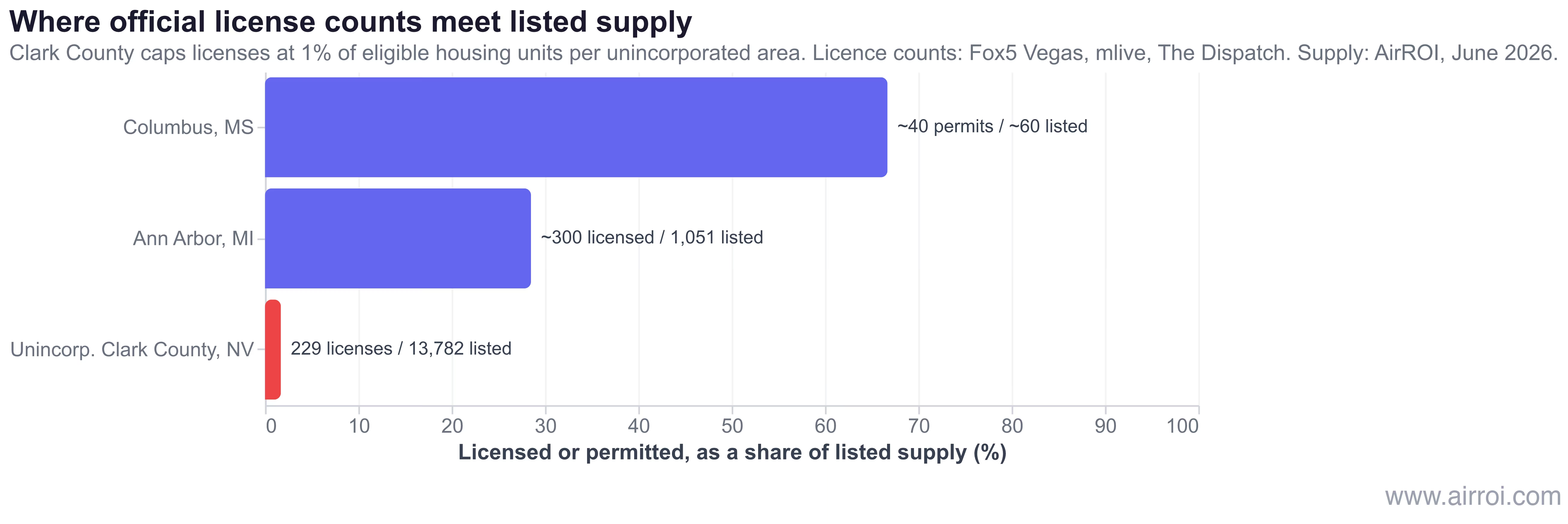
Set against jurisdictions where the numbers can be checked the same way, Clark County is an extreme outlier. Columbus, Mississippi has permitted about two-thirds of its listed supply. Ann Arbor's roughly 300 licensed units cover something over a quarter of the 1,051 listings AirROI observes there. Unincorporated Clark County sits at about 1.7%.
A listing can therefore be unlicensed for at least four distinct reasons:
- Evasion — the operator knows the rules and ignores them.
- No scheme exists — the jurisdiction has never created a registration system.
- A cap makes licensing unavailable — the Clark County case, where supply of licenses is fixed far below demand.
- A moratorium froze new certificates — the applicant is in a queue that is not moving.
Payment interdiction cannot distinguish among these. It reads one bit: licensed, or not. The operator gaming the system and the operator who entered a lottery in 2022 and lost both get the same off switch.
Riverside County is the live illustration of the fourth category, and it moved in the opposite direction this month. On July 28, 2026, the Board of Supervisors voted 5-0 to approve revisions ending a roughly 16-month moratorium on new short-term rental certificates in B-Bar H Ranch and Thousand Palms, covering 59 combined properties. It was the first of two required hearings; final adoption is set for August 25, 2026. The same package tightened enforcement elsewhere — suspension now follows three citations rather than five, revocation five rather than seven, and the 60-minute self-correction window was eliminated. A county can open a licensing door and raise penalties in the same motion, and Riverside just did.
The fairness objection was made most sharply by someone with a license to lose. Sierre Wolfkostin, a licensed Airbnb superhost, told Ann Arbor's City Council in July 2026 that a blanket moratorium would hit the wrong people:
"You would be effectively punishing the small business owners instead of the people who actively ignore your rules."
The precedent: this has already been done
Payment interdiction is not a Clark County invention. Treating the proposal as unprecedented misreads it; the mechanism has a track record, which is exactly why the county reached for it.
New Orleans went further in a different direction: since March 2025, platforms facilitating a booking must verify that the property holds a city-issued permit before the booking can proceed, with penalties of $1,000 per illegal listing per day. Austin requires platforms to stop facilitating bookings of unlicensed properties and to remove unlicensed listings within ten days of city notice.
What Clark County adds is not the mechanism but the motive. Elsewhere, payment interdiction was a first-choice design. Here it is a second attempt after the first was enjoined, which makes it a test of whether the transaction-side approach really is the durable one.
| Jurisdiction | What it does | Status as of July 29, 2026 |
|---|---|---|
| Clark County, NV | Bar platforms from processing payment for unlicensed STRs | Proposed — commissioners hear it Aug 4, 2026 |
| Riverside County, CA | Countywide ordinance revision; moratorium lifted in two areas | Tentatively approved 5-0, Jul 28; second reading Aug 25 |
| Salt Lake City, UT | Licensing, two-night minimum, 200-night annual cap, density limits | In effect since Jul 1, 2026 |
| Ann Arbor, MI | Scanning-based detection; moratorium ordinance drafting directed | Resolution passed 8-1, Jul 20 — moratorium itself not adopted |
| New York, NY | Booking services barred from processing unregistered transactions | In force |
| New Orleans, LA | Platforms must verify a city permit before booking | In force since Mar 2025 |
| Winnipeg, MB | Primary-residence bylaw with per-owner limits | In force since Apr 1, 2024; under review |
| Columbus, MS | Registration and annual permit | In force since Oct 2025; cap only under exploration |
Salt Lake City's ordinance, effective July 1, 2026, is a useful counterpoint because it works the host side hard: a two-night minimum stay, a 200-night annual cap, one license per resident, and density limits capping buildings over ten units at 10% of their units. Licenses cost $198 plus $342 per unit, and unlicensed operation draws up to $1,000 every seven days. It is a thorough piece of drafting — and it still depends on the city finding the violators.
What hosts should verify now
Four checks, in order, and none of them require a lawyer.
Do you hold a current, valid certificate — not an application, not a pending renewal? Platform-level rules read a binary. A lapsed license and no license look identical to a payment processor.
If you do not hold one, is a cap or moratorium the reason? This changes your options entirely. If your market's licensing is capped or frozen, waiting for enforcement to arrive is not a strategy, because there is no compliance path to arrive at. Track when the window reopens and what the allocation method is.
This article is analysis, not legal advice. Short-term rental rules change quickly and vary by parcel; confirm your position with your local licensing authority or counsel before acting.
Where the mechanism goes next
If the Clark County proposal is adopted on August 4 and survives the challenge that will certainly follow, it becomes a template — and the more useful way to see it is as the third step in a sequence rather than a novelty.
The sequence runs: fine the host, then require the platform to remove the listing, then stop the platform from paying. Each step moves further from the host and closer to the money, and each was adopted because the previous one underdelivered. Fines failed because cities could not find the addresses. Takedown mandates ran into Section 230. Payment interdiction is what remains once those two are exhausted, and its appeal is precisely that it does not depend on locating anyone.
The obstacles are real and worth naming rather than waving at. The county's appeal is unresolved, and an adverse ruling would shape what it can do next. State preemption forecloses this route entirely in Arizona and constrains it in Texas and elsewhere. Most markets lack the listing-level license data the mechanism requires. And the platforms will not concede quietly — Airbnb public policy manager John LoPorto's response to Ann Arbor's proposed moratorium signals the register the industry will use, arguing such measures strip residents of "a vital source of income that helps pay mortgages and property taxes."
The opposition in Las Vegas reads the proposal as a sign of weakness. "They're desperate," said Jackie Flores of the Greater Las Vegas Short-Term Rental Association. "They know that they're going to lose."
She may be right about the appeal. But the mechanism does not depend on the appeal, and that is the part hosts should sit with. For a decade, the worst realistic outcome of operating without a license was a fine you could model. The direction of travel is toward an outcome you cannot model, because it does not scale with how much you earn — it decides whether you earn. In a county where 229 licenses exist for 13,782 listings, that distinction is not academic.
Frequently Asked Questions
It depends on whether your city enforces against you or against the platform. Under host-level enforcement you face fines — Salt Lake City charges up to $1,000 every seven days, Ann Arbor $200 to $1,000 per ticket. Under the platform-level approach Clark County proposed in July 2026, the consequence differs in kind: the platform is barred from completing the transaction, so the booking never converts to revenue at all.
No. It is a proposed amendment to Clark County Code scheduled to be heard by the Board of Commissioners on August 4, 2026, and nothing takes effect unless the board adopts it. A separate federal case over the county's earlier platform rules also remains on appeal after Judge Miranda Du enjoined those provisions on August 28, 2025.
Cities have already done exactly that. New York City's Local Law 18 prohibits booking services from processing transactions for unregistered short-term rentals, and New Orleans requires platforms to verify a city permit before a booking completes, with penalties of $1,000 per illegal listing per day. The Ninth Circuit upheld this design in HomeAway.com v. City of Santa Monica in 2019.
Tentatively. On July 28, 2026 the Board of Supervisors voted 5-0 to approve revisions ending the roughly 16-month moratorium on new short-term rental certificates in B-Bar H Ranch and Thousand Palms, covering 59 combined properties. That was the first of two required hearings, with final adoption scheduled for August 25, 2026.
Check whether listings in your market publish a license number at all, because that is the practical test of whether platform-level enforcement is even possible there. AirROI data from June 2026 shows the range runs from 62.8% of Honolulu listings down to 23.4% in Las Vegas, and in markets including Salt Lake City, Charleston and Phoenix the platform surfaces no license field whatsoever.