
Spain Supreme Court Voids STR Registry: What AirROI Data Shows About Fragmented Enforcement

Amsterdam hosts earn $313 per night with 5,552 competing listings. Madrid hosts earn $181 per night with 17,660. The difference between those two numbers is enforcement -- and Spain's Supreme Court just ensured the gap gets wider. On May 21, 2026, the Spain Supreme Court issued Sentence 620/2026, voiding the national short-term rental registry created by Royal Decree 1312/2024. The court ruled that the central government lacked constitutional authority to impose a nationwide STR registration system that duplicated the existing registries of Spain's 17 autonomous communities. The ruling landed exactly one day after EU Regulation 2024/1028 took operational effect across all 27 member states -- a regulation that depends on national registries for enforcement.
The timing is not merely ironic. It reveals a structural contradiction in European STR enforcement that AirROI data quantifies across five major markets: enforcement quality, not enforcement existence, determines host revenue. And Spain just fragmented its enforcement into 17 separate systems.
What Spain's Supreme Court Actually Ruled
The court's reasoning was direct: the central government's registry constituted "an exhaustive regulation at the national level" that improperly overlapped with autonomous community registries. Under Spain's constitution, tourism is a devolved power -- the Comunidades Autonomas set the rules, not Madrid.
What the court annulled:
- The national registration requirement (NRUA numbers)
- Annual rental declarations tied to the registry
- The obligation for owners to obtain a national registry number before listing on platforms
What the court preserved:
- The Digital Single Window (Ventanilla Unica Digital de Arrendamientos / VUDA)
- Platform data-transmission obligations (Airbnb, Booking.com must still share data)
- Statistical data exchange between authorities
"Since they have been so brave about saying it has to be them, let's see if they do it, because the rights of many people are at stake." -- Isabel Rodriguez, Spain's Housing Minister, responding to the ruling
The challenge to regions is clear: you claimed this authority, now exercise it. Whether Spain's 17 autonomous communities can build enforcement infrastructure that matches what the central government attempted remains the open question.
The May 20 Contradiction: EU Regulation Meets Regional Reality
The timing of the ruling exposes a structural gap in European STR enforcement. EU Regulation 2024/1028 took operational effect on May 20, 2026, requiring every member state to establish a Single Digital Entry Point (SDEP) for STR data collection, mandate platform data-sharing, and enforce registration verification. Spain's Supreme Court voided the national registry the next day.
Spain's ruling preserves the data pipeline but removes the registration teeth. The Digital Single Window survives, meaning Airbnb and Booking.com must still transmit booking data to Spanish authorities. But there is no national registration number for platforms to verify -- each of the 17 autonomous communities operates its own system with different license types: HUT in Catalonia, VFT in Andalusia, VUT in most other regions, and ETV in the Balearic Islands.
"Previously, rental platforms didn't share data, making it hard to enforce city rules. This new law changes that, giving cities more control." -- MEP Kim van Sparrentak, European Parliament
| Element | Status Post-Ruling | Implication |
|---|---|---|
| National Registry (NRUA) | Annulled | No national registration number required |
| Annual rental declarations | Annulled | Owners not obligated to file nationally |
| Digital Single Window (VUDA) | Preserved | Data exchange infrastructure survives |
| Platform data transmission | Preserved | Airbnb/Booking.com still share booking data |
| Regional registries | Unaffected | 17 autonomous community systems remain primary |
What AirROI Data Reveals About Enforcement and Revenue
The conventional narrative -- that regulation kills STR markets -- does not survive contact with the data. AirROI analysis of five major European STR markets reveals a consistent pattern: markets with stricter, centralized enforcement maintain higher ADR and stronger per-listing economics. Markets with fragmented enforcement produce the opposite.
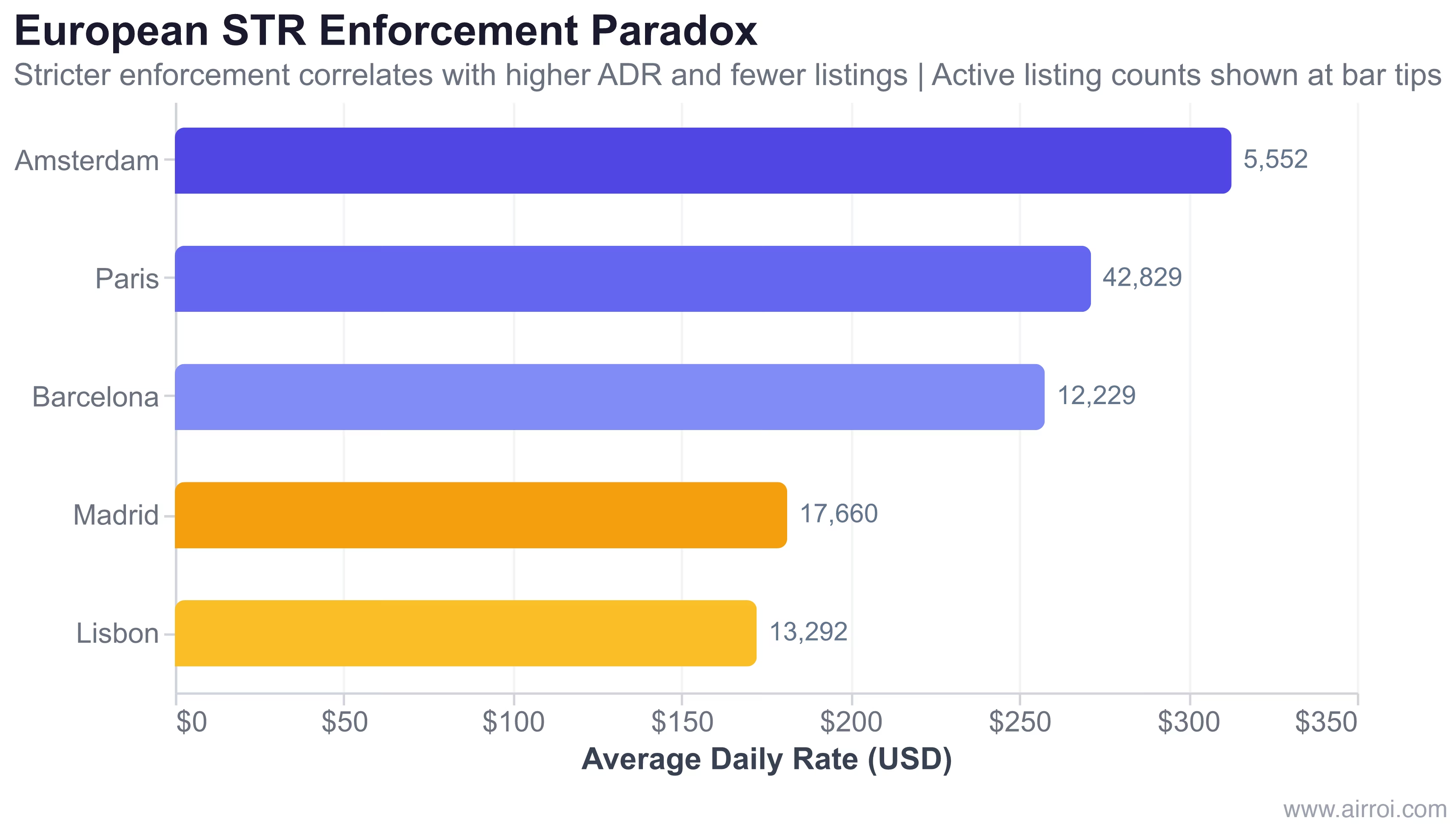
| Market | Active Listings | Occupancy | ADR (USD) | RevPAR (USD) | Annual Revenue (USD) | Enforcement Model |
|---|---|---|---|---|---|---|
| Amsterdam | 5,552 | 50% | $312.90 | $153.90 | $29,798 | 30-night cap, permit required |
| Paris | 42,829 | 53% | $271.30 | $148.20 | $30,902 | 120-night cap, Declaloc ID |
| Barcelona | 12,229 | 57% | $257.60 | $156.40 | $36,732 | License freeze, 2029 phaseout |
| Madrid | 17,660 | 56% | $181.30 | $105.30 | $25,352 | Regional jurisdiction |
| Lisbon | 13,292 | 55% | $172.30 | $98.70 | $25,767 | RNAL/AL registration |
Amsterdam commands a $313 ADR -- 73% higher than Madrid's $181 -- while operating with fewer than one-third the active listings. The mechanism is supply compression: strict enforcement removes non-compliant operators, reducing supply and enabling remaining hosts to charge higher rates. This is not theoretical. Amsterdam's 30-night annual cap limits its STR market to 5,552 active listings, creating scarcity that produces Europe's highest nightly rate.
Paris tells a similar story. Active listings dropped 25.3% from their July 2025 peak of 57,361 to 42,829 in April 2026, driven by pre-deadline enforcement of France's Declaloc registration system. Despite the contraction, Paris maintains a $271 ADR and $30,902 in annual revenue per listing.
The contrast with Madrid is instructive. With 17,660 active listings and fragmented regional oversight from the Community of Madrid's autonomous government, the market produces a $181 ADR -- the lowest among the five markets analyzed. Higher supply, lower enforcement intensity, lower per-night revenue.
The Barcelona Paradox
Barcelona sits at the intersection of every contradiction in European STR enforcement. The city plans to eliminate all 10,101 HUT (tourist apartment) licenses by November 2028, effectively banning short-term rentals in residential buildings by 2029. Spain's Constitutional Court upheld this plan in March 2025, ruling it does not constitute expropriation requiring compensation. Yet Barcelona simultaneously produces the highest per-listing revenue among major Spanish markets.
AirROI data shows Barcelona generating $36,732 in median annual revenue with a $258 ADR and 57% occupancy -- higher than either Amsterdam or Paris on an annual revenue basis despite Barcelona's aggressive regulatory posture. The mechanism is the same supply compression effect observed across all strictly enforced markets: fewer licensed operators splitting the same demand produces premium economics for those who remain.
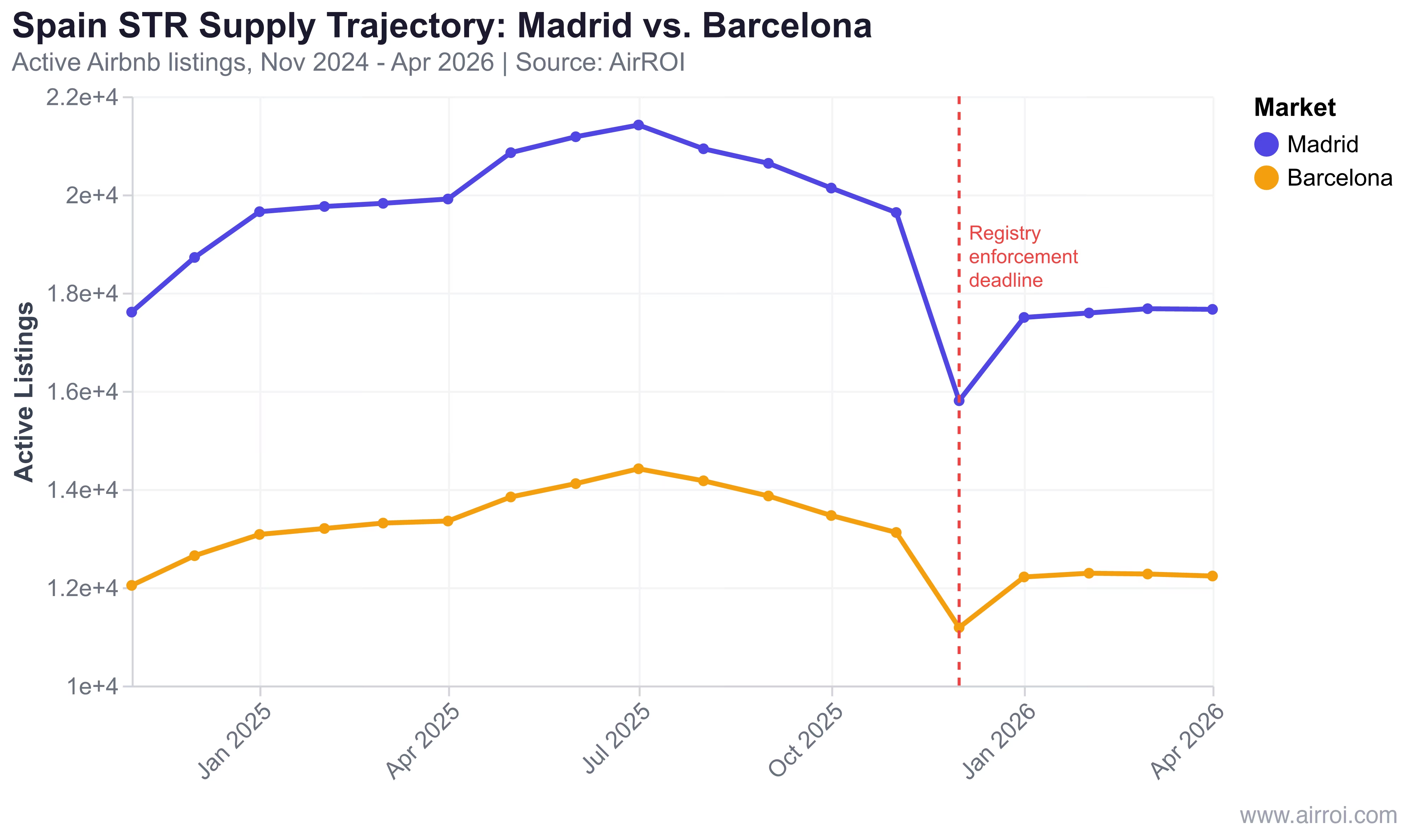
Barcelona's listings peaked at 14,413 in July 2025 and declined to 12,229 by April 2026 -- a 15.2% contraction. Madrid saw a steeper absolute decline, from 21,414 to 17,660 (17.5%), with the sharpest drop to 15,799 in December 2025 coinciding with the national registry enforcement deadline.
The Supreme Court ruling changes nothing for Barcelona hosts. The city's license freeze and phaseout are driven by Catalonia's regional government and Barcelona's municipal authority -- precisely the level of government the Supreme Court confirmed has constitutional jurisdiction. Barcelona's enforcement infrastructure is local, not national, and it remains fully intact.
"No economic interest should be above the right to housing, and no company, no matter how large and powerful, can be above the law." -- Pablo Bustinduy, Spain's Minister for Social Rights, Consumer Affairs and Agenda 2030
This creates a paradox for investors: the very regulation that will eliminate Barcelona's STR market is currently producing its best-ever per-listing economics. Remaining license holders earn premium revenue precisely because the supply pipeline is closed. The window is 2.5 years before the phaseout completes, and smart operators are already planning transitions to mid-term rentals (32+ days), a segment growing at 12% year-over-year in Barcelona.
A Three-Speed Europe: What This Means for STR Hosts and Investors
The Spain ruling crystallizes what AirROI data has been showing for months: Europe is not one STR market with one regulatory framework. It is a continent operating at three distinct speeds, and the speed determines host economics.
Tier 1: Centralized enforcement with strict rules -- Amsterdam, Paris. These markets have functioning national registration systems, active enforcement, and quantified restrictions (night caps, mandatory IDs). They produce the highest ADR and the strongest per-listing revenue. Compliance is the competitive moat. Amsterdam's 30-night cap generates a $313 ADR with just 5,552 listings. The barrier to entry protects incumbent operators.
Tier 2: Aggressive local enforcement -- Barcelona, Balearic Islands. These markets operate independent of the national framework. Catalonia's HUT system and the Balearic Islands' ETV licenses predate the national registry and survived its annulment. Barcelona's $36,732 annual revenue per listing demonstrates that local enforcement can be more effective than national enforcement -- when the local authority is committed.
Tier 3: Fragmented or weak enforcement -- Madrid and most Spanish autonomous communities without robust local systems. The Supreme Court ruling leaves these markets relying on regional governments that may lack the infrastructure, political will, or resources to enforce STR registration at the level the national system attempted. The result is higher supply, lower ADR, and less revenue per listing.
For investors, this three-tier framework requires a fundamentally different approach to European STR due diligence. Key steps:
- Verify regional compliance -- check your specific autonomous community's registration system, not the defunct national registry
- Assess enforcement quality -- a region with registration requirements on paper but no enforcement produces Madrid-level economics, not Amsterdam-level
- Price regulatory risk -- Barcelona's premium revenue comes with a 2.5-year countdown; Madrid's lower revenue comes with regulatory uncertainty
- Monitor data-sharing impact -- platform data-transmission obligations survived the ruling, meaning authorities retain visibility even without a national registry
- Track compensation proceedings -- FEVITUR's €160M claim against the state may establish precedent for regulatory taking in the STR sector
The broader lesson extends beyond Spain. As Ben Schroeter, Director for Economic Policy at Booking.com, wrote in The Regulatory Review, EU Regulation 2024/1028 "materially alters evidentiary standards for policymaking" by providing property-level activity data. The data infrastructure survives regardless of which government level operates the registry. What matters is whether authorities use it.
Frequently Asked Questions
Spain's Supreme Court (Sentence 620/2026, May 21, 2026) annulled the national short-term rental registry created by Royal Decree 1312/2024, ruling the central government lacked constitutional authority to create a national registry that duplicated existing regional systems. The court preserved the Digital Single Window and platform data-sharing obligations required under EU Regulation 2024/1028.
Not directly. The court preserved the Digital Single Window (VUDA) and platform data-transmission obligations that implement EU Regulation 2024/1028. However, the ruling removes the national registration infrastructure the EU regulation assumed would exist, creating an enforcement gap in Spain specifically.
Minimally. Barcelona's license freeze and 2029 phaseout are driven by Catalonia's regional government and Barcelona's municipal authority, not the national registry. All 10,101 HUT licenses still expire by November 2028 regardless of the Supreme Court ruling. Barcelona maintains the highest per-listing revenue among major Spanish markets at $36,732 annually.
AirROI data shows Barcelona leads at $36,732 median annual revenue, followed by Paris ($30,902), Amsterdam ($29,798), Lisbon ($25,767), and Madrid ($25,352). Markets with stricter enforcement tend to maintain higher per-listing revenue through supply compression.
Verify compliance with your specific regional tourism authority rather than the defunct national registry. Ensure your listing displays the correct regional registration number. Platform data-sharing obligations survive the ruling, so transparency requirements persist. Monitor whether your autonomous community strengthens or relaxes enforcement in response.