
Airbnb's Super-App Pivot: What the 2026 Summer Release Means for Host Revenue

One-bedroom Airbnb hosts in New York City earn $19,297 per year at $219 ADR -- sitting squarely in the pricing band where Airbnb's new boutique hotels now compete with price match guarantees and 15% booking credits. Three-bedroom hosts in the same city earn $48,385. Hotels cannot touch them. That gap -- and which side of it your listing falls on -- is the single most important takeaway from Airbnb's 2026 Summer Release, the platform's most ambitious structural expansion since launching Experiences. CEO Brian Chesky told CNBC this is Airbnb becoming "an Amazon for services," and for the first time, the airbnb super app travel platform 2026 vision has teeth: car rentals, grocery delivery, luggage storage, airport pickups, and thousands of boutique hotels across 20 global cities.
This is not feature bloat. It is a deliberate pivot from marketplace to platform -- and it changes the competitive equation for every host differently depending on property type, location, and guest segment.
What Airbnb Actually Announced in the 2026 Summer Release
On May 20, 2026, Airbnb launched five new service categories alongside expanded AI features. Here is every component of the airbnb summer release 2026 hosts need to understand, with the specific partners, pricing incentives, and availability:
| Service | Partner | Availability | Guest Incentive |
|---|---|---|---|
| Car Rentals | Coming later summer 2026 | Global (at launch) | 20% credit on first rental toward future Airbnb stay |
| Grocery Delivery | Instacart | 25+ US cities | $0 delivery + $10 off orders over $50 |
| Luggage Storage | Bounce | 15,000+ locations in 175 cities | 15% off for Airbnb guests |
| Airport Pickups | Welcome Pickups | 160+ cities worldwide | 20% off every ride, flight tracking |
| Boutique Hotels | Curated independents (no chains) | 20 cities: NYC, London, Paris, Madrid, Rome, Singapore, more | Price match guarantee (up to $400 credit) + 15% credit toward future home booking |
The release also introduced 3,000 guided landmark visits and 2,500+ food culture Experiences, plus exclusive FIFA World Cup 2026 activations across host cities.
From Marketplace to Super App: The "Amazon for Services" Thesis
Airbnb is no longer a marketplace that connects hosts and guests. It is becoming a platform that monetizes the full trip.
"I imagine one day we'll have dozens, possibly even hundreds of categories, just like Amazon. I think we can build a little bit, like an Amazon for services, at least for traveling and living." -- Brian Chesky, CEO of Airbnb, CNBC interview, May 20, 2026
The strategic logic is straightforward. Airbnb's Q1 2026 earnings showed 18% revenue growth to $2.68 billion, with 156.2 million nights and seats booked. App-based bookings grew 22% year-over-year and now account for 63% of total nights -- up from 58% a year ago. First-time booker growth accelerated to 10%, the highest since early 2022. The platform is consolidating its mobile-first position, and every new service category creates another reason for guests to stay inside the Airbnb ecosystem.
The conversion data validates the approach. According to Airbnb, nearly 25% of guests who are new to the platform and book an Experience go on to book a stay or service, and roughly one in three Experience bookers book a stay within 90 days. Each new service category -- car rentals, groceries, luggage storage -- functions as an entry point that pulls users deeper into the Airbnb flywheel.
What this means for hosts: Airbnb takes a 10-15% commission from third-party service providers (car rentals, luggage storage, airport pickups), creating a revenue stream independent of host bookings. As the platform monetizes more of the trip, its economic incentive to optimize exclusively for host bookings dilutes. The algorithm may increasingly prioritize listings and contexts where guests use multiple services -- urban locations with Instacart coverage, areas with car rental demand, markets where the full-trip experience is seamless.
This does not mean hosts become irrelevant. Accommodations remain the core product. But hosts are no longer the only product.
Hotels on Airbnb: Which Host Segments Face Real Competition
But the competitive threat is highly segmented. Airbnb positions hotels for 1-2 night urban stays, business trips, and last-minute bookings -- the exact segments where urban one-bedroom STR hosts operate. The price match guarantee (up to $400 in Airbnb credits) and 15% credit toward a future home booking create a pricing floor that undercuts STR operators competing on rate alone.
AirROI data across five hotel-expansion cities reveals which hosts sit in the competitive crosshairs:
1-Bedroom STR Performance in Hotel-Expansion Cities
| Market | Active 1-BR Listings | ADR | Occupancy | Annual Revenue | RevPAR |
|---|---|---|---|---|---|
| New York | 3,888 | $219 | 46% | $19,297 | $109 |
| Miami | 3,088 | $202 | 50% | $25,049 | $102 |
| San Francisco | 1,586 | $205 | 54% | $25,692 | $116 |
| Nashville | 1,646 | $194 | 49% | $25,559 | $97 |
| Los Angeles | 3,300 | $167 | 49% | $17,203 | $89 |
Source: AirROI market data, May 2026. Revenue reflects trailing twelve months.
These 13,508 one-bedroom listings across five cities operate at ADRs between $167 and $219 -- landing directly in the $150-$300 boutique hotel pricing band. For a guest choosing between a $205/night San Francisco studio and a curated boutique hotel at the same price with price match guarantee and 15% credit toward a future stay, the hotel's value proposition is increasingly competitive, especially for short stays where kitchen and laundry access offer minimal advantage.
The critical counterweight, however, is the guest acquisition funnel argument. CFO Mertz disclosed that 55% of guests who book a hotel on Airbnb return to book a home. Hotels expand the guest pool rather than redistributing existing demand. For the platform as a whole, this is net positive. For individual 1-BR hosts competing head-to-head with hotel listings in the same search results, the immediate experience is pressure on rates and visibility.
The Multi-Bedroom Moat: What Doesn't Change
The data tells a sharply different story for hosts with multi-bedroom properties. AirROI data from the same hotel-expansion cities shows 3+ bedroom listings earn 2.4x-3.7x more annual revenue than their 1-bedroom neighbors:
3+ Bedroom STR Performance in the Same Cities
| Market | Active 3+BR Listings | ADR | Occupancy | Annual Revenue | Revenue vs 1-BR |
|---|---|---|---|---|---|
| New York | 949 | $517 | 49% | $48,385 | 2.5x |
| Miami | 1,580 | $576 | 48% | $67,818 | 2.7x |
| Nashville | 2,734 | $502 | 44% | $62,409 | 2.4x |
| Los Angeles | 2,554 | $640 | 47% | $63,474 | 3.7x |
Source: AirROI market data, May 2026.
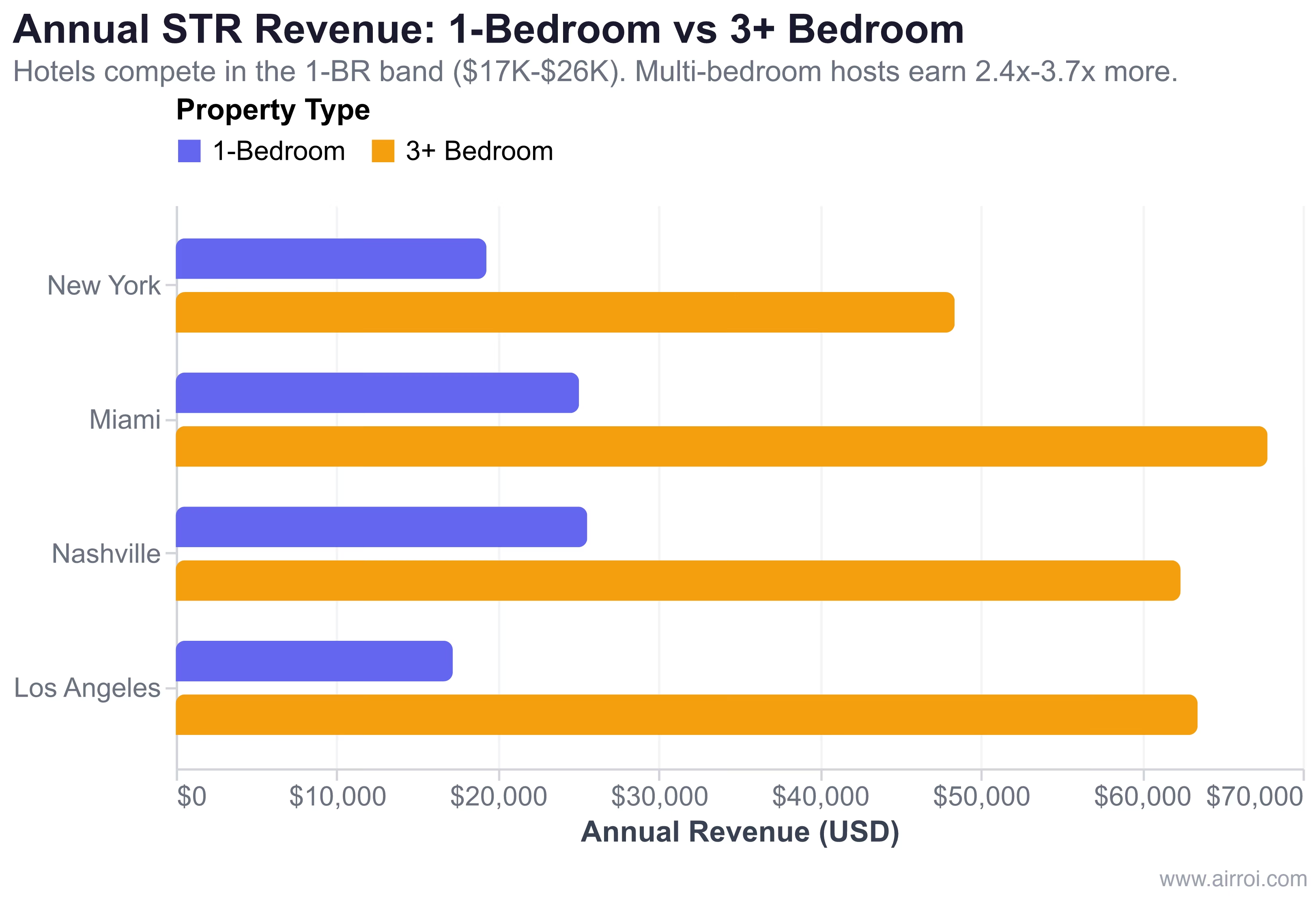
The revenue gap is structural, not cyclical. A three-bedroom property in Los Angeles earns $63,474 annually at $640 ADR -- a segment no boutique hotel on Airbnb occupies. Hotels compete in the $150-$300 band. Multi-bedroom STRs operate at $502-$640. These are different markets that happen to share a platform.
What hotels cannot replicate:
- Space and bedrooms -- a 4-bedroom cabin sleeps 8-12 guests; a hotel room sleeps 2
- Full kitchens -- families and groups traveling for 3+ nights prefer cooking over dining out
- Privacy and character -- a Gatlinburg cabin with a hot tub and mountain views offers an experience fundamentally different from a hotel room
- Longer stays -- the average 3+BR stay in Nashville is 3.4 nights; hotel positioning targets 1-2 night stays
Interestingly, some of the new services may actually benefit rural and unique-property hosts. Grocery delivery via Instacart solves a genuine guest pain point in remote vacation markets where the nearest store may be a 30-minute drive. Car rental integration reduces booking friction for guests traveling to areas that require driving. These services complement the multi-bedroom and rural STR experience rather than competing with it.
Positioning Your Listing in Airbnb's Super-App World
The strategic response differs by property type. Here is what hosts should consider as the platform evolves:
For Urban 1-Bedroom Hosts (Highest Exposure)
Shift away from the hotel's sweet spot. Hotels target 1-2 night stays from business and last-minute travelers. Raise your minimum night requirement to 3 nights to capture couples, remote workers, and extended-stay guests -- segments where a full kitchen and in-unit laundry provide genuine advantage over a hotel room.
For Multi-Bedroom and Unique-Property Hosts (Low Exposure)
Lean into what hotels cannot offer. Emphasize space, kitchens, privacy, and local character in your listing. The super-app pivot makes standard accommodations more commoditized. Properties that provide experiences hotels fundamentally cannot replicate -- a lakefront cabin, a mountain retreat, a villa with a private pool -- become more differentiated, not less.
Consider new services as guest experience enhancers. Mention grocery delivery availability in your listing description. For remote properties, highlight that guests can order groceries through Airbnb to arrive before check-in. Car rental integration makes your listing more accessible if it requires driving from the nearest airport.
For All Hosts
Understand dynamic pricing in a hotel-competitive environment. Hotels use sophisticated revenue management systems. Hosts competing in the 1-BR urban segment need to price dynamically -- not just by season, but by day-of-week, booking lead time, and local events. Static pricing in a market where hotels adjust rates hourly means leaving money on the table during peaks and losing bookings during troughs.
"Every service Airbnb platforms is one fewer differentiator you can offer." -- Rental Scale Up analysis, May 2026
This warning applies to property managers more than individual hosts. But the principle holds: as Airbnb bundles more services into the guest experience, hosts must articulate their edge through the property itself -- space, uniqueness, hospitality, and location -- not through ancillary services the platform now provides.
Frequently Asked Questions
For most hosts, no. Airbnb's hotel expansion targets urban supply gaps in regulation-restricted cities like New York, London, and Madrid. AirROI data shows direct competition concentrates on 1-bedroom listings at $167-$219 ADR. Multi-bedroom hosts (3+ bedrooms) earn 2.4x-3.7x more annual revenue and operate at ADR levels ($502-$640) far above boutique hotel pricing.
CEO Brian Chesky envisions Airbnb as a full-trip platform with hundreds of service categories. Airbnb takes 10-15% commission from third-party providers, creating revenue independent of host bookings. Hosts benefit if bundled services improve guest satisfaction. The risk is that algorithmic priority may shift toward contexts where guests use multiple platform services.
Airbnb guarantees hotel prices match the lowest available rate elsewhere, crediting up to $400 in app credits, and offers 15% credit toward a future home booking. This creates a pricing floor for 1-2 night urban stays where boutique hotels and 1-bedroom STRs overlap in the $150-$300 ADR band.
Multi-bedroom properties (3+ bedrooms), unique and rural listings, and properties offering amenities hotels cannot replicate -- full kitchens, yards, hot tubs, and in-unit laundry. AirROI data shows 3+ bedroom listings in hotel-expansion cities earn $48,385-$67,818 annually at ADR levels of $502-$640, a segment entirely outside the boutique hotel competitive range.
Hotel room nights are growing more than double the rest of Airbnb's business, per CFO Ellie Mertz on the Q1 2026 earnings call. However, hotels still represent a small fraction of total nights booked. Critically, 55% of hotel bookers return to book a home on Airbnb, suggesting hotels function as a guest acquisition funnel rather than a zero-sum competitor.