
Smart Pricing

Key Takeaways
- Smart Pricing is free and built into every Airbnb listing — no setup or subscription required
- The algorithm adjusts rates daily based on demand, seasonality, day of week, and local events, within the host's minimum and maximum price bounds
- Smart Pricing optimizes for occupancy rather than revenue — a fundamental design difference from third-party tools
- In practice it suggests rates 10-30% below market value, particularly during high-demand dates when full-price bookings would have come anyway
- Professional hosts typically replace it with dedicated dynamic pricing tools that target revenue per available night (RevPAR) rather than raw booking rate
How Smart Pricing Works
Smart Pricing feeds a machine-learning model with multiple demand signals and outputs a suggested nightly rate for each calendar date. Airbnb applies that rate automatically so long as it falls within the host's configured range:
| Factor | How It Affects Price |
|---|---|
| Seasonality | Raises rates during peak seasons; lowers during off-peak windows |
| Day of week | Weekend rates typically higher than weekday |
| Local events | Increases prices during concerts, festivals, and conferences |
| Listing demand | Adjusts based on views, saves, and booking momentum for your listing |
| Market supply | Considers how many similar listings are available on each date |
| Booking lead time | May discount rates as a date approaches if it remains unbooked |
Enabling Smart Pricing:
- Go to your listing's Pricing settings in the Airbnb host dashboard
- Toggle "Smart Pricing" on
- Set your minimum price — the floor below which Airbnb will not drop your rate
- Set your maximum price — your ceiling rate for any single night
- Airbnb recalculates and updates rates daily within your bounds
The minimum price is the single most consequential decision a host makes inside Smart Pricing. Setting it too low is the most common cause of underpriced bookings.
ADR Across Six STR Markets
Smart Pricing operates against the backdrop of dramatically different average daily rates across U.S. short-term rental markets. A tool calibrated to "optimize" bookings in Scottsdale (median ADR: $421) faces a completely different revenue-opportunity set than one running in Denver ($222), even if occupancy rates are similar.
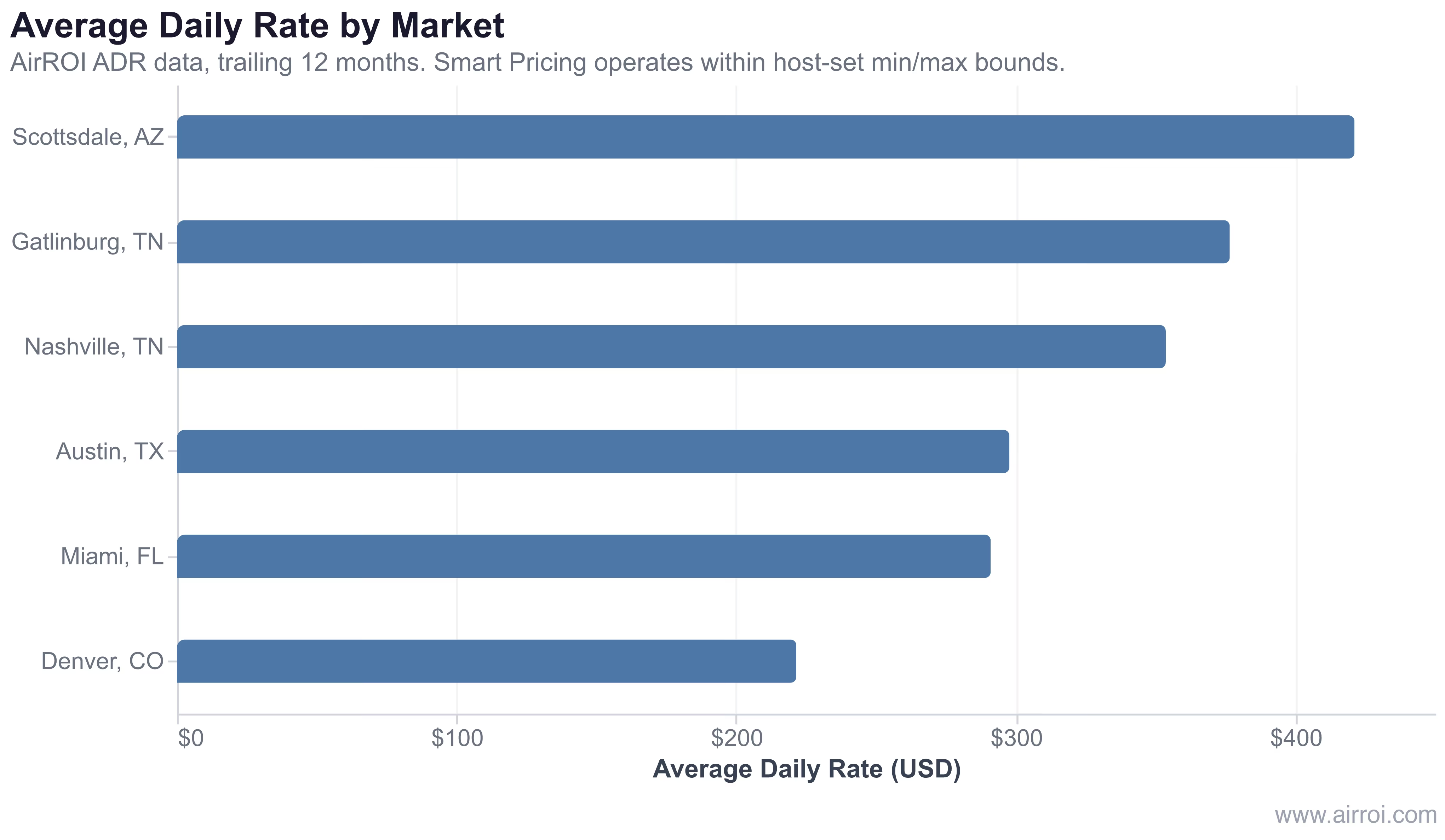
In AirROI's analysis of 34,515 active listings across Scottsdale, Gatlinburg, Nashville, Austin, Miami, and Denver, median ADR ranges from $221.50 in Denver to $421.10 in Scottsdale — a 90% spread. A pricing tool that underprices by 15% in Scottsdale costs a host roughly $63 per night; the same 15% underpricing in Denver costs $33. The stakes of Smart Pricing's occupancy-first bias scale with the market's rate ceiling.
Smart Pricing's occupancy bias is not a bug — it reflects Airbnb's platform incentive to fill nights. The platform earns its service fee on completed bookings, not on maximizing host revenue. Hosts who understand this misalignment can compensate with a well-set minimum price and manual overrides for high-demand dates.
Smart Pricing Limitations
| Limitation | Impact |
|---|---|
| Occupancy-biased | Optimizes for booking rate, not total revenue — the two often diverge on peak dates |
| Tends to underprice | Frequently suggests rates 10-30% below market value, especially around high-demand events |
| Limited customization | No control over pricing strategy, comp set, or market-specific rules |
| No multi-platform support | Only adjusts rates on Airbnb, not useful for cross-listed properties |
| Basic market intelligence | Less market depth than third-party tools, which subscribe to forward-booking demand signals |
| No forward-looking data | Reacts to current booking pace rather than using pacing data weeks or months ahead |
Smart Pricing vs Third-Party Dynamic Pricing
| Feature | Smart Pricing | Third-Party Tools (PriceLabs, Beyond, Wheelhouse) |
|---|---|---|
| Cost | Free | $10-30/month per listing |
| Optimization target | Occupancy | RevPAR / total revenue |
| Revenue lift vs base | Moderate | 10-40% more revenue typical |
| Customization | Min/max bounds only | Custom rules, seasonality adjustments, comp set selection, event calendars |
| Multi-platform | Airbnb only | Airbnb, Vrbo, Booking.com, more |
| Market data depth | Basic demand signals | Forward-looking pacing, comp set ADR, market-level trend data |
| Event awareness | General signals | Custom event calendars with pricing rules per event |
Why ADR Management Matters Beyond Smart Pricing
Tips for Using Smart Pricing Effectively
- Set your minimum price at break-even or above — this is the most important Smart Pricing decision; calculate your full cost per night (mortgage or rent allocation, utilities, cleaning, platform fees, supplies) and never set the floor below it
- Review and override high-demand dates manually — Smart Pricing will not reliably capture full-market value for major holidays, local festivals, or graduation weekends; override those dates with a manually held rate
- Monitor your ADR trend monthly — if ADR declines after enabling Smart Pricing, the minimum price is too low or the maximum is capping peak-night revenue
- Use Smart Pricing as a baseline while learning your market — then consider upgrading to a dedicated dynamic pricing tool once you understand your market's demand seasonality
- Check your occupancy rate — if you're consistently hitting 60%+ occupancy, Smart Pricing has likely been underpricing; the market would have booked you at a higher rate
- Set a realistic maximum — an unrealistically high ceiling prevents Airbnb from boosting rates during genuine demand spikes, but a ceiling that's too low caps your upside on peak dates
Frequently Asked Questions
Smart Pricing is a free and convenient starting point, but most experienced hosts find it tends to underprice listings. It optimizes for occupancy rather than revenue, often suggesting rates 10-30% below what the market will bear. Hosts seeking maximum revenue typically switch to third-party dynamic pricing tools.
Smart Pricing analyzes demand signals such as seasonality, local events, day of week, listing type, and market trends to suggest nightly rates. You set minimum and maximum price bounds, and Airbnb adjusts your rate daily within that range. The algorithm updates prices automatically without host intervention.
Third-party dynamic pricing tools like PriceLabs, Beyond, and Wheelhouse offer more granular control, market-specific data, and customizable strategies. They typically generate 10-40% more revenue than Smart Pricing by optimizing for total revenue rather than just occupancy.
Smart Pricing is designed to prioritize booking velocity, so it often does lift occupancy by dropping rates when demand is soft. The tradeoff is that it can leave significant revenue on the table during peak periods — filling dates at discounted rates that the market would have booked anyway at a higher price.
Your minimum price should be at or above your full break-even cost per night — mortgage or rent, utilities, cleaning fees amortized per stay, platform fees, and supplies. Most hosts set their minimum at 80-90% of their target nightly rate so the algorithm has room to react to low-demand periods without triggering a loss.