Rental Arbitrage

Key Takeaways
- Rental arbitrage profits from the spread between long-term lease cost and short-term nightly revenue — no property purchase required
- Startup capital runs $5,000–$15,000 per unit for furnishing and setup, enabling faster scaling than ownership
- Written landlord permission and full local STR regulatory compliance are absolute requirements before signing a lease
- Break-even occupancy analysis is the most critical financial calculation, since monthly rent is a fixed cost regardless of bookings
- The model offers no equity building or depreciation tax benefits — ROI is purely cash-flow driven
How Rental Arbitrage Works
Rental arbitrage compresses a property investment into four economic steps:
- Identify a market where STR nightly rates reliably exceed long-term rent on the same unit type — this spread is the arbitrage
- Secure written permission from the landlord via a lease addendum explicitly permitting short-term subletting; without it, listing the property violates the lease and can result in eviction
- Furnish and list the unit on Airbnb, VRBO, and direct-booking channels; quality furnishing ($3,000–$8,000 per bedroom) is an investment, not a cost — it drives ratings and repeat bookings
- Operate the spread: collect nightly revenue, pay fixed monthly rent, and net the difference after cleaning, utilities, platform fees, and insurance
Profitability Example
| Item | Monthly Amount |
|---|---|
| Average monthly STR revenue | $5,200 |
| Long-term lease payment | −$1,800 |
| Cleaning costs (8 turnovers) | −$720 |
| Utilities (host-paid) | −$250 |
| Platform fees (3%) | −$156 |
| Supplies and consumables | −$120 |
| WiFi and streaming | −$80 |
| STR insurance rider | −$100 |
| Monthly profit | $1,974 |
| Annual profit | $23,688 |
The leverage is real: that $1,974/month profit on a $12,000 furnishing investment is a 197% cash-on-cash return in year one — before any unit-two expansion.
Annual STR Revenue by Market
Choosing the right market is the highest-leverage decision in rental arbitrage. The chart below shows AirROI's median annual revenue per active listing for seven high-opportunity markets — the revenue side of the arbitrage equation.
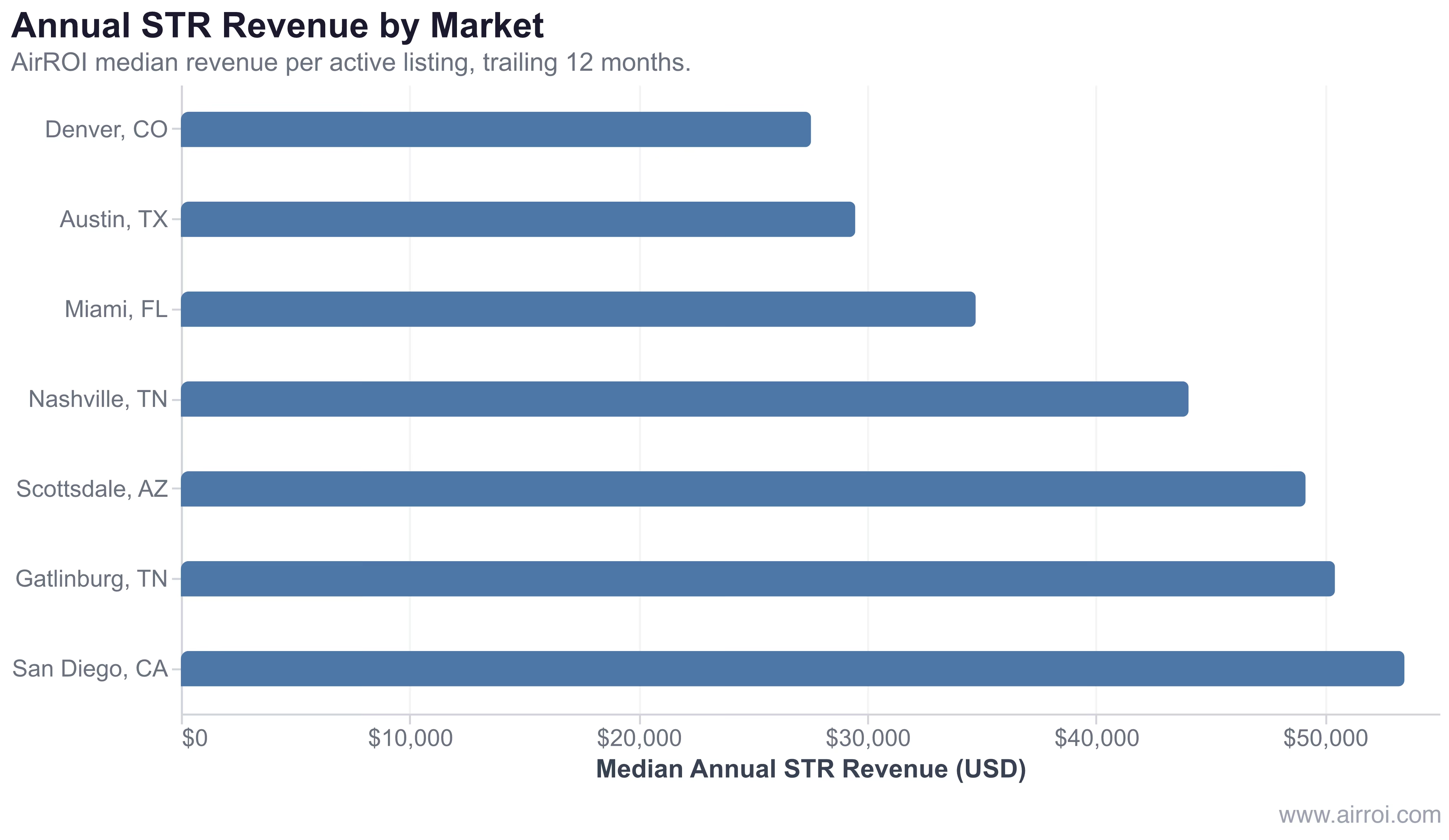
In AirROI's analysis of more than 47,000 active listings across these seven markets, San Diego leads at $53,472 median annual revenue, followed by Gatlinburg ($50,438) and Scottsdale ($49,153). The widest arbitrage spreads tend to appear in resort and Sun Belt markets where STR demand is structurally high but long-term rents — the arbitrageur's fixed cost — remain moderate relative to nightly pricing.
The arbitrage opportunity is largest where nightly demand is driven by tourism rather than business travel: resort markets generate consistently high ADR with short average stays, which maximizes revenue per turn and widens the spread over a fixed monthly lease.
Rental Arbitrage vs. Property Ownership
| Factor | Rental Arbitrage | Property Ownership |
|---|---|---|
| Startup capital | $5,000–$15,000 | $60,000–$150,000+ |
| Monthly fixed cost | Lease payment | Mortgage + taxes + insurance |
| Equity building | None | Yes |
| Tax benefits | Limited | Depreciation, mortgage interest, 1031 exchange |
| Appreciation upside | None | Yes |
| Exit flexibility | Do not renew lease | Must sell property |
| Landlord control risk | High | None |
| ROI on cash invested | Often 100–200%+ | Typically 10–30% |
Market and Regulatory Due Diligence
Before signing any lease:
- Verify that your city permits short-term rentals in the target neighborhood (zoning matters)
- Confirm STR permit and business license requirements; get both before listing
- Register for occupancy tax collection — most jurisdictions require it from day one
- Monitor local government agendas for pending STR ordinance changes
Scaling a Rental Arbitrage Portfolio
Single-unit arbitrage is operationally fragile. One slow month can turn a profitable unit cash-flow negative. The standard playbook is to reach 3–5 units within 12–18 months so that strong performers subsidize any underperforming unit and revenue is diversified across booking windows.
Key scaling considerations:
- Build landlord relationships proactively: offer above-market rent, provide monthly property condition reports, carry STR-specific insurance, and give landlords direct contact information. Landlord confidence is the rate-limiting factor for portfolio growth.
- Standardize furnishings across units: a modular kit that works across unit types reduces per-unit setup cost and speeds time-to-listing when a new lease is signed
- Use dynamic pricing software: automating rates is critical when managing multiple calendars; manual pricing at scale leaves occupancy and ADR on the table
- Track break-even occupancy per unit: each unit has its own fixed cost (rent) and variable revenue profile; operators who monitor this at the unit level spot underperformers before they become losses
Frequently Asked Questions
Rental arbitrage is legal when you have explicit written permission from the property owner to sublet as a short-term rental, comply with local STR regulations and licensing requirements, and follow all lease terms. Many cities require STR permits, business licenses, and tax registration. Never list a property on Airbnb without landlord consent — doing so violates most standard lease agreements and can result in eviction.
Airbnb rental arbitrage profits typically range from $500 to $3,000 per month per unit, depending on the market, property type, and occupancy. AirROI data shows median annual STR revenue of $53,472 in San Diego and $44,039 in Nashville — markets where a disciplined arbitrageur can clear $1,500–$2,500/month per unit after rent and operating expenses.
The biggest risks are lease non-renewal or termination by the landlord, changes in local STR regulations that restrict or ban short-term rentals, and seasonal revenue dips that may not cover rent. Unlike property ownership, arbitrage offers no equity building or depreciation tax benefits, so the entire business depends on maintaining landlord relationships and consistent occupancy above your break-even threshold.
Markets with high STR revenue, moderate long-term rents, and light regulation offer the widest arbitrage spreads. AirROI data ranks San Diego ($53,472 median annual STR revenue), Gatlinburg ($50,438), and Scottsdale ($49,153) at the top. Avoid heavily regulated markets like New York, where minimum-night rules (median 25.8 nights) effectively eliminate the short-stay revenue model.
Most rental arbitrage operators spend $5,000–$15,000 per unit for furnishing, security deposits, and initial setup — compared to $60,000–$150,000 for a down payment on a purchased property. The lower capital requirement allows faster scaling: many operators reach 3–5 units within 12–18 months of launching their first.