Average Length of Stay (ALOS)

Average Length of Stay (ALOS) is the mean number of nights guests stay per reservation, calculated by dividing total booked nights by total reservations. It is one of the most operationally significant metrics in short-term rental management — ALOS determines how often your cleaning crew mobilizes, how many orphan-night gaps appear in your calendar, and how efficiently each booked night converts to net revenue.
Key Takeaways
- ALOS = Total Booked Nights ÷ Number of Reservations
- Longer stays reduce per-night turnover costs and calendar fragmentation
- AirROI data shows ALOS ranging from 3.4 nights (Gatlinburg, TN) to 10.2 nights (New York, NY) across major US markets
- ALOS interacts with ADR and occupancy rate to determine total RevPAR
- Regulatory minimums, not just guest preference, can dramatically shift a market's ALOS
How to Calculate ALOS
Formula:
ALOS = Total Booked Nights ÷ Number of Reservations
Example:
In a given month, your listing had 8 reservations totaling 26 booked nights:
ALOS = 26 ÷ 8 = 3.25 nights per booking
To see the cost impact, assume each turnover costs $130 in cleaning and preparation:
| ALOS | Turnover Cost per Booked Night |
|---|---|
| 3 nights | $43.33 |
| 5 nights | $26.00 |
| 7 nights | $18.57 |
| 14 nights | $9.29 |
Doubling ALOS from 3 to 6 nights cuts the per-night overhead burden by more than half — without raising the nightly rate a single dollar.
ALOS Across US Short-Term Rental Markets
AirROI's trailing 12-month data across 12 active US markets reveals wide ALOS variation driven by property type, guest mix, and local regulation:
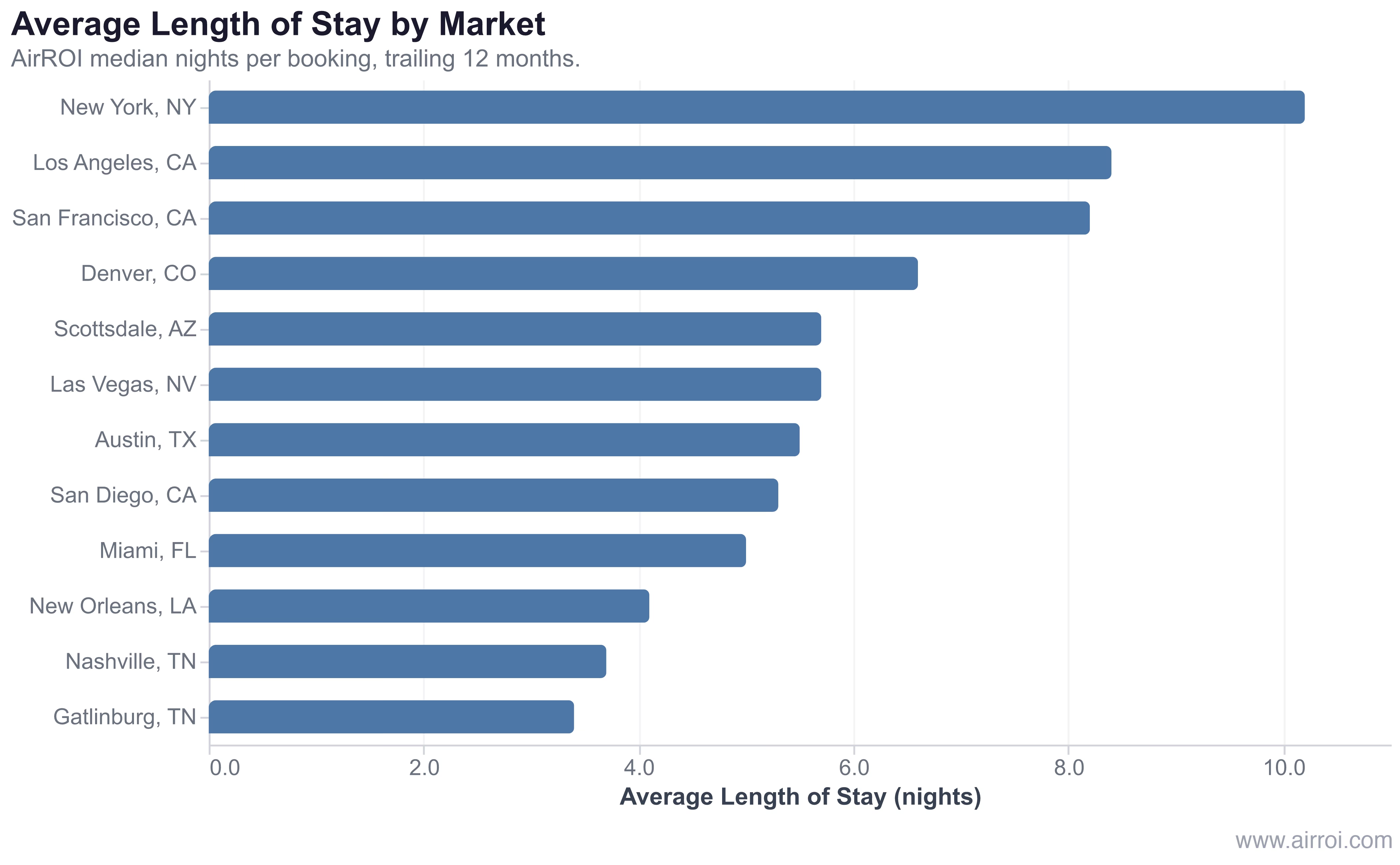
In AirROI's analysis of more than 78,000 active listings across these 12 markets, median ALOS ranges from 3.4 nights in Gatlinburg to 10.2 nights in New York. New York's outlier figure reflects Local Law 18's effective 30-night minimum requirement, which compressed active short-stay listings by roughly 90% since enforcement began in September 2023 — the remaining listings skew toward extended-stay guests.
| Market | ALOS (nights) | Active Listings |
|---|---|---|
| New York, NY | 10.2 | 11,468 |
| San Francisco, CA | 8.2 | 4,355 |
| Los Angeles, CA | 8.4 | 10,134 |
| Denver, CO | 6.6 | 3,739 |
| Scottsdale, AZ | 5.7 | 4,310 |
| Las Vegas, NV | 5.7 | 3,419 |
| Austin, TX | 5.5 | 8,774 |
| San Diego, CA | 5.3 | 9,560 |
| Miami, FL | 5.0 | 7,905 |
| New Orleans, LA | 4.1 | 5,007 |
| Nashville, TN | 3.7 | 6,165 |
| Gatlinburg, TN | 3.4 | 3,622 |
Resort and entertainment markets like Nashville and Gatlinburg see short, concentrated stays — weekend getaways dominate. Coastal and business markets cluster in the middle. Urban markets with regulatory pressure sit at the high end.
Gatlinburg's 3.4-night ALOS and New York's 10.2-night ALOS represent the same metric measuring entirely different phenomena: one is driven by the rhythm of cabin weekend trips, the other by a legal minimum-stay mandate.
Why ALOS Matters for STR Operators
- Turnover cost control: Each guest changeover requires cleaning, laundry, restocking, and inspection — fixed costs that erode margin when spread across short stays. A 3-night ALOS generates twice as many turnovers per 30 days as a 6-night ALOS.
- Calendar gap reduction: Short stays create orphan nights — unbookable 1- or 2-night gaps between reservations. A calendar running 2-night stays will accumulate significantly more dead nights than one running 5-night stays.
- Revenue per available night: ALOS is one input into RevPAR. Optimizing ALOS improves the denominator efficiency (fewer wasted nights) without requiring higher nightly rates.
- Operational scheduling: Your ALOS determines how frequently you need a cleaning team, restocking deliveries, and linen service. A 3-night average means roughly 10 turnovers per month for a single property; a 7-night average cuts that to fewer than 5.
- Booking lead time alignment: Markets with longer ALOS tend to book further in advance. Nashville's 3.7-night stays come with 54.8-day lead times; Gatlinburg's 3.4-night stays arrive 57.7 days out. Understanding that correlation helps calibrate when to open availability and when to enforce minimums.
ALOS Benchmarks by Property Type
| Property Type | Typical ALOS | Key Drivers |
|---|---|---|
| Urban business travel | 5-10+ nights | Corporate stays, regulatory minimums |
| Urban leisure | 3-5 nights | Weekend and holiday getaways |
| Beach/coastal vacation | 5-7 nights | Saturday-to-Saturday patterns |
| Mountain/ski resort | 3-5 nights | Weekend warriors, week-long vacations |
| Rural/nature retreat | 3-5 nights | Long weekend escapes |
| Extended stay/furnished | 14-30+ nights | Relocations, remote workers |
How to Optimize Your ALOS
Set strategic minimum stays. During high-demand periods, require 3-night minimums on weekends and 5-7 nights over holidays. This filters out single-night bookings that leave gaps and drive up turnover frequency. Lower the minimum to fill orphan slots during shoulder seasons.
Calibrate length-of-stay discounts carefully. A 10-15% weekly discount typically pays for itself in reduced turnover costs and fewer unbookable gaps. A 25-30% discount rarely does — the revenue loss exceeds the operational savings. Test incrementally and track RevPAR, not just occupancy.
Reduce orphan nights proactively. When a 2-night gap appears between two bookings, temporarily drop your minimum to 2 nights for those specific dates rather than leaving them empty. Dynamic pricing tools can automate this.
Frequently Asked Questions
A good ALOS depends on your market and strategy. AirROI data shows urban markets like New York averaging 10.2 nights per booking due to 30-night minimum rules, while resort markets like Nashville average 3.7 nights and Gatlinburg 3.4 nights. For most traditional vacation rentals, a 4-7 night ALOS balances strong per-night rates with manageable turnover costs.
Divide the total number of booked nights by the total number of reservations in the period. For example, if you had 60 booked nights from 15 reservations, your ALOS is 4.0 nights per booking. Track this monthly to spot trends and measure whether minimum-stay or discount changes are working.
Generally yes, because longer stays reduce per-night turnover costs, cleaning expenses, and calendar gaps between bookings. However, excessive weekly discounts that are too steep reduce overall revenue. The goal is the ALOS that minimizes turnover costs while preserving strong ADR — typically found by testing 10-15% weekly discounts rather than 25-30%.
ALOS directly shapes how easily you can fill your calendar. Short ALOS creates more orphan nights — unbookable gaps between reservations — which reduces effective occupancy. Longer stays fill the calendar more completely, but may require length-of-stay discounts that compress ADR. The optimal ALOS maximizes RevPAR, not just occupancy or ADR alone.
Yes, significantly. AirROI data across 12 US markets shows ALOS ranging from 3.4 nights (Gatlinburg, TN) to 10.2 nights (New York, NY). New York's high ALOS reflects Local Law 18's 30-night minimum requirement, not guest preference. Resort markets cluster around 3-6 nights, while regulatory-constrained urban markets skew toward extended stays.