Maui Planners Reject Most Exemptions to the Condo Vacation-Rental Ban

Maui's planning commission has urged the County Council to reject most proposed exemptions from the county's vacation-rental ban, keeping the island's lower-priced resort condos on course to stop taking tourists by 2031.
Those condos filled an estimated 49% of the Airbnb nights booked in South and West Maui over the past year, more than their 45% share of listings, according to AirROI, a short-term-rental data firm. It tracked 7,774 active entire-home rentals there and matched most of them to buildings by name or map location.
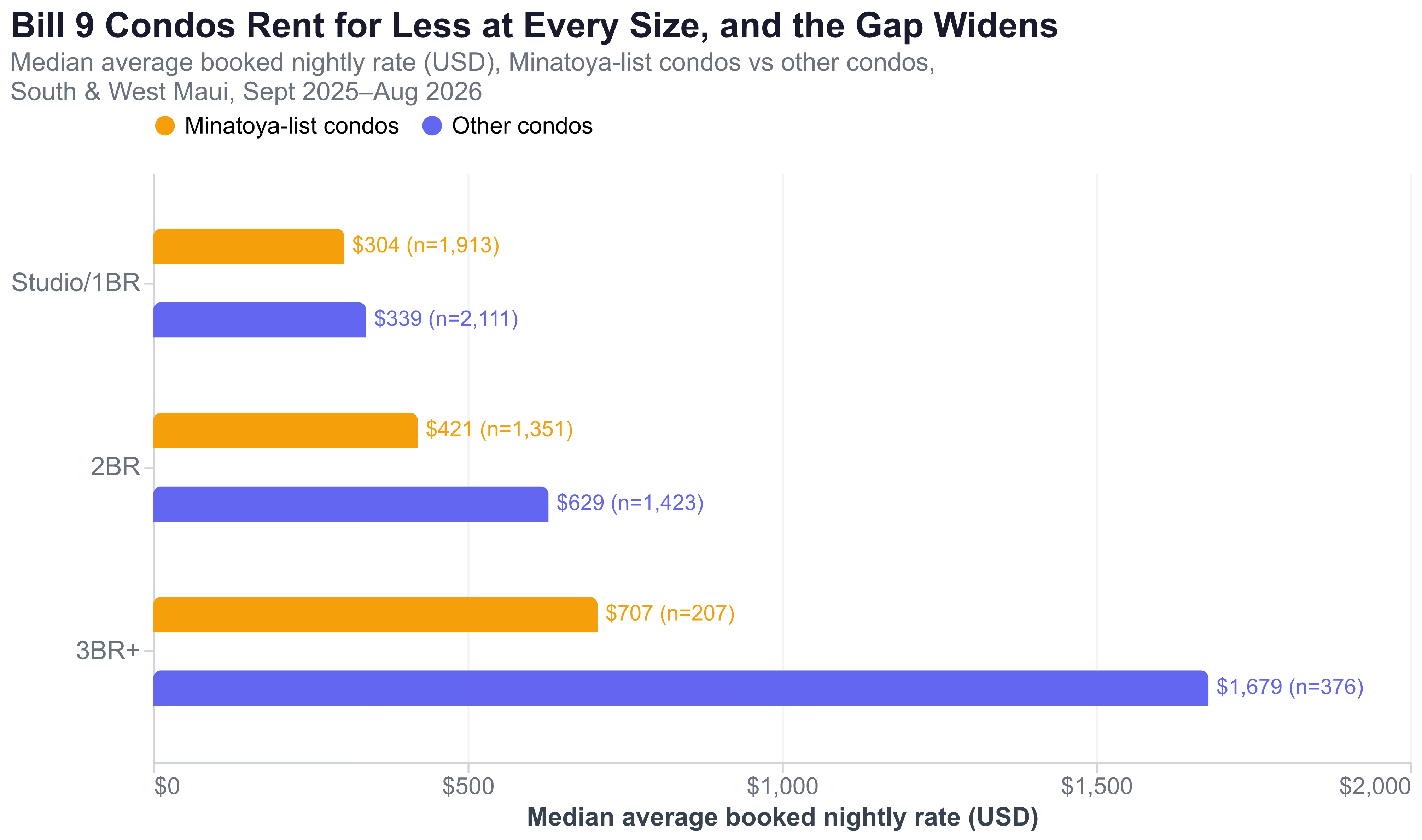
They are cheaper and busier. The median condo on the county's phase-out list booked at about $370 a night, roughly a fifth less than condos the ban leaves alone, and it filled over a third more nights.
At stake is where Maui's budget travelers stay, what owners earn and the homes the county hopes those units become. On Airbnb alone, list condos in South and West Maui booked more than 480,000 nights over the past year.
The exemption fight decides a smaller slice: rentals in the 48 properties the Council put forward booked about two-fifths of those nights, and those in the five the commission endorsed a small fraction.
The decision now moves to a County Council that can overrule the commission only with a two-thirds vote, and whose makeup will change after the Nov. 3 election.
Bill 9, which Mayor Richard Bissen signed last December, repeals the exception that let apartment-zoned buildings on the so-called Minatoya list, 104 properties with more than 7,000 units, run as vacation rentals. Those in West Maui can take guests through 2028, and the rest through 2030.
"Ninety-four percent of the units affected are owned by people who don't live in Maui County, and most don't even live in Hawaiʻi," Bissen said in the release announcing his signature.
Five properties out of 48
The exemptions would move buildings into two hotel districts that took effect in June, letting them keep renting to visitors. On Sept. 22, after five hours of testimony, the commission voted 6-2 to recommend denying that rezoning for all but five of the 48 properties the Council had put forward, the Honolulu Star-Advertiser reported. The majority wanted more objective standards for granting exemptions.
The 43 properties it turned down hold more than 1,400 Airbnb listings in South and West Maui, which booked some 184,000 nights over the past year.
| Properties on the county list, South and West Maui | Airbnb listings | Booked nights, past year | Share of the list's nights |
|---|---|---|---|
| In the 48 the Council proposed | 1,513 | 195,000 | 40.5% |
| Of those, the 5 the commission endorsed | 69 | 11,000 | 2.3% |
| Of those, the 43 it recommended denying | 1,444 | 184,000 | 38.2% |
| In neither proposal | 2,010 | 287,000 | 59.5% |
One owner inside the 48 defended the package. "It may not be what one side or the other wants entirely, but we have a compromise that represents a lot of collaboration," Wendy King, a Maui resident who owns a short-term rental on the exemption list, told the commission on Sept. 22.
"This is an absolute slap in the face," said Nara Boone of the Maui Housing Hui, who testified against the exemptions at the same hearing.
Properties in neither group booked three-fifths of the list's nights. Greg Pfost of the Planning Department said more applications may come, "including 32 properties that the Council has been considering based on their proximity to the shoreline."
The budget end of the market
Condos on the list took in 39% of the area's booked revenue over the year, less than their share of nights. Guests book them often and pay less each time.
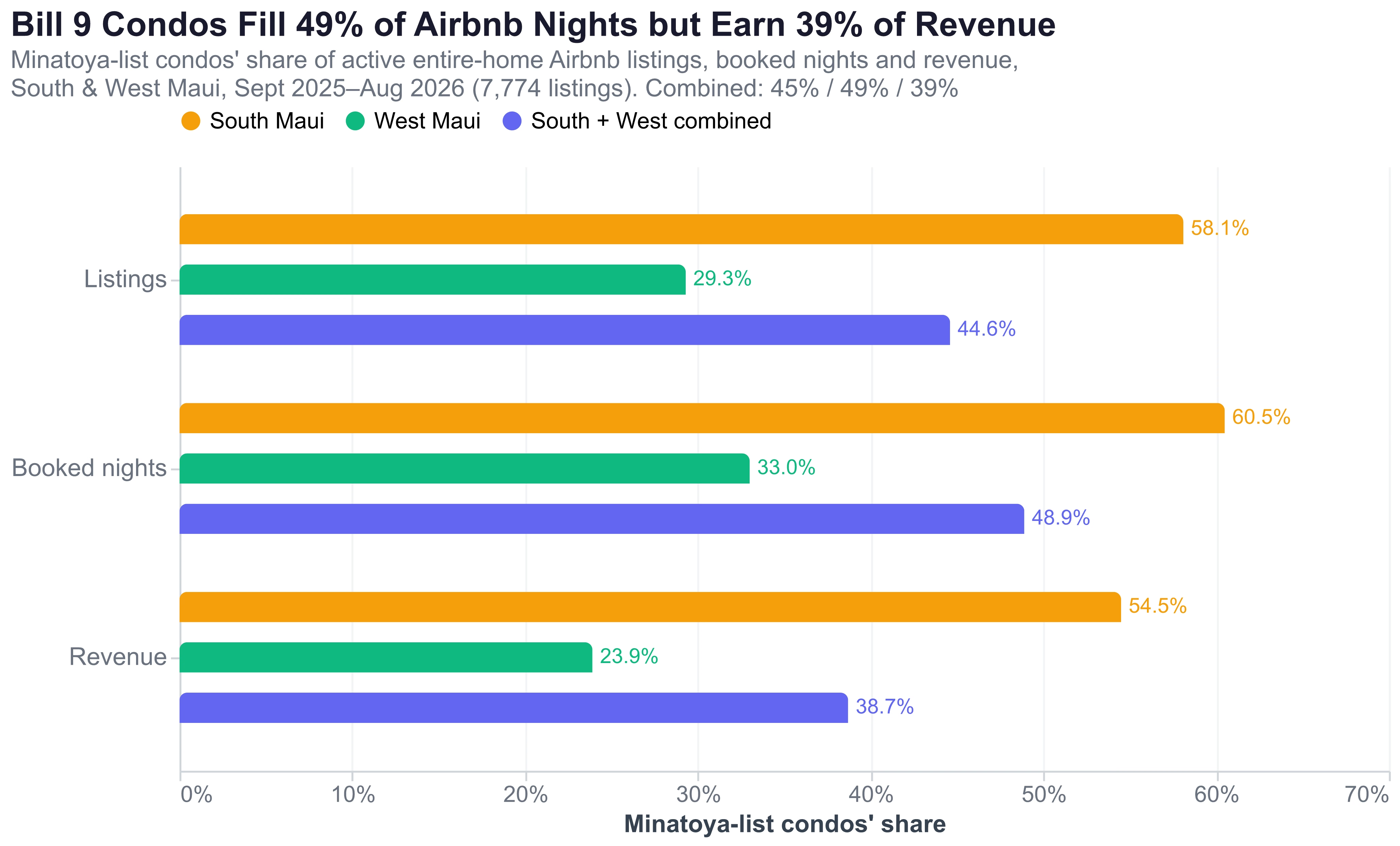
The exposure is heaviest in South Maui, where Minatoya buildings hold nearly three-fifths of Airbnb listings, against under a third in West Maui.
The discount grows with size. List studios and one-bedrooms book about a tenth below other condos, and list two-bedrooms about a third below. At three bedrooms and up, condos outside the list book at more than twice the rate.
The median list condo booked 120 nights over the year, against 88 for other condos, and took in about the same, just over $50,000.
Age tracks much of the gap. Every property on the county's list is more than three decades old, because the old exception covered only apartment buildings approved by April 20, 1989.
A separate county list covers other buildings allowed to rent. Its condos built before 1995 booked studios and one-bedrooms at a median of about $300 a night, close to list condos. Those built since 2000, chiefly Honua Kai, booked at about $780. In larger units, even the older buildings on that second list charge more than Minatoya condos.
On one stretch of West Maui, they run together. Papakea, a 1970s complex, is among the properties the commission turned down. Its one-bedrooms booked at a median $383 a night and filled 83 nights over the year. One-bedrooms at Honua Kai, the hotel-zoned resort nearby, booked at about twice the rate and filled 57.
In Kīhei, they part. Kamaole Sands, the list's largest property at 440 units, was also turned down. Its one-bedrooms booked at a median $304 a night, while those at Kihei Akahi, an older hotel-zoned complex on the same road, booked at $275 and filled fewer nights. There the ban would end rentals at the busier building and spare its cheaper neighbor.
The line is deliberate. Since 1989, county zoning has required apartment-district buildings to be occupied long term, except those already approved, and Bill 9's findings say the county "is in a housing crisis that has increased in severity."
Commissioner Mark Deakos, who moved to deny the hotel-zoning framework itself, said at the commission's Feb. 24 meeting: "This commission voted. The County Council voted in favor of Bill 9, which essentially said we decided we wanted to phase those uses out of those units."
The Council's housing chair sees the rezoning as naming what the buildings already do. "The use is continuous, the use is the same," Nohelani Uʻu-Hodgins said at a May 26 committee meeting.
One owner told the commission on Sept. 22 that his unit was never an ordinary apartment. "I did not purchase a conventional Maui apartment and later convert it into a vacation rental. … The distinction matters," said Vittorio Favati, who owns one of 42 leasehold units at Kahana Village.
Who takes the guests
At the Council's final vote in December, some who testified named the hotels as winners. William Forsyth, a former boat captain, told the Council the law would "increase hotel zone occupancy rates," perhaps from about 60% to 90%, "which would be fantastic." Hotel workers with the ILWU said condo rentals were "cannibalizing occupancy rates at traditional hotels," in Maui Now's words.
Expedia Group, Vrbo's parent, took the other side. "We are deeply concerned about the significant economic harm to local residents and small businesses if Bill 9 is implemented in its current form," spokesperson Glenna Wong said in a statement the day the bill passed.
The University of Hawaiʻi Economic Research Organization, in a 2025 study commissioned by the Hawaiʻi Community Foundation, estimated that ending apartment-district rentals could shrink Maui County's visitor lodging by a quarter.
It put the average 2023 rate for Maui vacation rentals at $368 a night, close to the list-condo median, against $591 for hotel units. Average lodging costs would rise with the changing mix even if rates did not, the economists wrote.
Bissen answered at the time that "economic models—while helpful—cannot fully shape the future of our communities," in a statement to Hawaiʻi Public Radio.
Owners are still booking
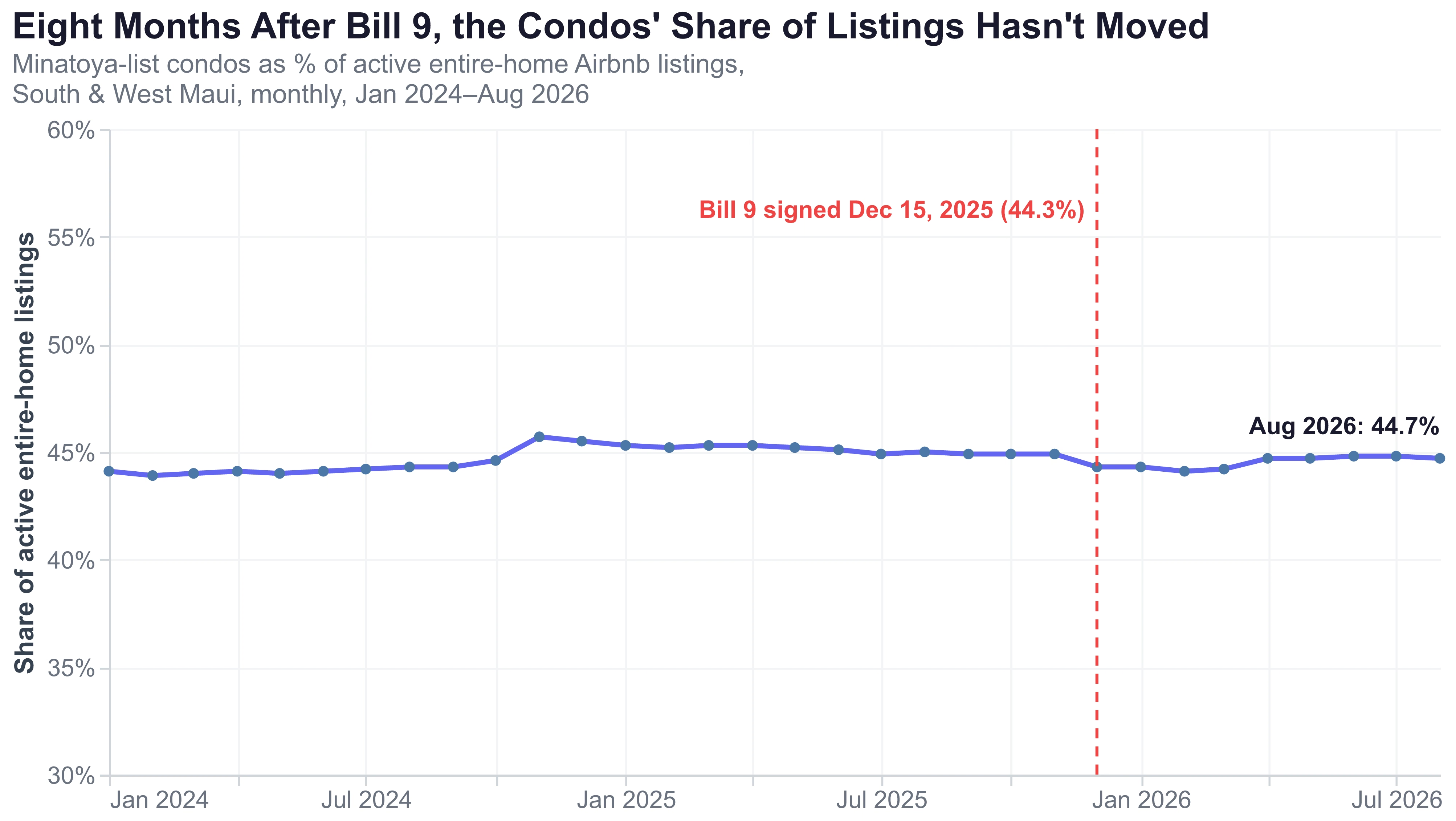
In August, list condos held a slightly larger share of active entire-home Airbnb listings in South and West Maui than when the bill was signed in December, AirROI's monthly figures show, and their share has stayed inside a two-point band since January 2024.
Their booked revenue kept growing, a little more slowly than other listings'. From January through August, list condos in South Maui took in about 5% more than a year earlier, against 8% for other listings there. In West Maui they took in 18% more, against 20%.
Few owners have switched their Airbnb listings to monthly stays: just 11 listings in list buildings now require stays of 28 nights or more, half as many as in December.
Under the ordinance, owners can keep that income for more than two years in West Maui and four elsewhere.
Owners at Kāʻanapali Royal, another of the properties the commission turned down, sued the county on Dec. 19. Their complaint says the county's conduct "has resulted in a total denial of plaintiffs' viable economic use of their property rising to the level of an unconstitutional per se regulatory taking." A second suit was filed as a class action for all list owners.
The county's corporation counsel does not comment on pending litigation, Maui Now reported.
Units are changing hands, mostly to buyers from elsewhere. Council member Tom Cook of South Maui, who introduced the hotel-zoning bill, presented sales data at a July 6 committee meeting showing that about 90% of buyers of list units between December and June came from off-island. "Some of these properties won't end up being local resident housing," he said.
The Office of Hawaiian Affairs reads the sales differently. "Bill 9 is already creating local housing opportunities," McKenna Woodward of OHA told the Council on July 24. Citing the county Department of Finance, she said a quarter of 101 affected properties sold after the law took effect went to local buyers.
Six votes and an election
On July 24 the Council voted 7-1, with one member absent, to send the two exemption resolutions to the commission. Overruling the commission's recommendation will take six of the nine votes.
The lone "no" came from Keani Rawlins-Fernandez of Molokaʻi. "Are we going to use our housing units for our residents to be able to live in and have shelter, or are we going to let off-island folks exploit our housing units to profit off of?" she asked at that meeting.
That vote only sent the resolutions for review, and a vote to refer is not a vote to approve, so the tally is no count of override votes. Three of the seven who said yes, Tamara Paltin, Shane Sinenci and Uʻu-Hodgins, had voted for Bill 9 itself on first reading.
Two of the seven won't be back after the Nov. 3 general election. Council Chair Alice Lee is retiring, and Vice Chair Yuki Lei Sugimura is giving up her seat to challenge Bissen for mayor. Both voted against Bill 9 on first reading, and Maui Now counts both among a five-member moderate bloc that "currently holds sway over the four progressives."
The Council has posted no date to take up the recommendation. Unless six members vote to spare them, Papakea's owners can host vacation renters until the last night of 2028, and Kamaole Sands' owners until the last night of 2030.
About the data: Trailing-year figures cover active entire-home Airbnb listings with minimum stays under 28 nights and at least one booked night, September 2025 through August 2026, in South Maui (Māʻalaea to Mākena) and West Maui (Lahaina to Kapalua).
Frequently Asked Questions
Minatoya-list condos in the West Maui community plan area may keep renting to visitors through the last day of 2028, and those elsewhere in Maui County through the last day of 2030. In both areas the use must cease the next day, New Year's Day. Explainers that show earlier dates describe the original proposal, not the ordinance as signed.
The county publishes the list as "Apartment District Properties Allowed to be Used for Short-Term Occupancy," and it names 104 properties by complex name and tax map key. Complexes on the county's separate non-apartment list, such as hotel-zoned Honua Kai or Kihei Akahi, fall outside the ban. The county treats the list as informational, so the Planning Department is the place to confirm a parcel.
It recommended denying hotel-zoning exemptions for 43 of the 48 properties the County Council proposed, the Honolulu Star-Advertiser reported. It backed Hale Kaanapali, Kuau Plaza, Maui Schooner, Hono Koa and Hana Kai. The vote is advisory, and the Council may still approve other exemptions with a two-thirds vote.
No. It ends short-term rentals only in apartment-zoned buildings on the Minatoya list, while hotel-zoned condos, permitted short-term rental homes, bed and breakfasts, timeshare units and uses operating under a variance continue. According to AirROI data, more than half of active entire-home Airbnb listings in South and West Maui sit outside the list.
Not so far. AirROI data show Minatoya-list condos made up a slightly larger share of active entire-home Airbnb listings in South and West Maui in August than when the bill was signed. Few of their Airbnb listings have switched to monthly minimum stays.